
Exterior Growth Guide · Eugene, OR
Moss vs. Algae vs. Lichen: How to Tell Them Apart on Eugene Homes
Green growth on a roof, siding, driveway, fence, or patio is not always the same problem. Texture, structure, thickness, and attachment reveal what you are looking at and help determine which cleaning method is safest.
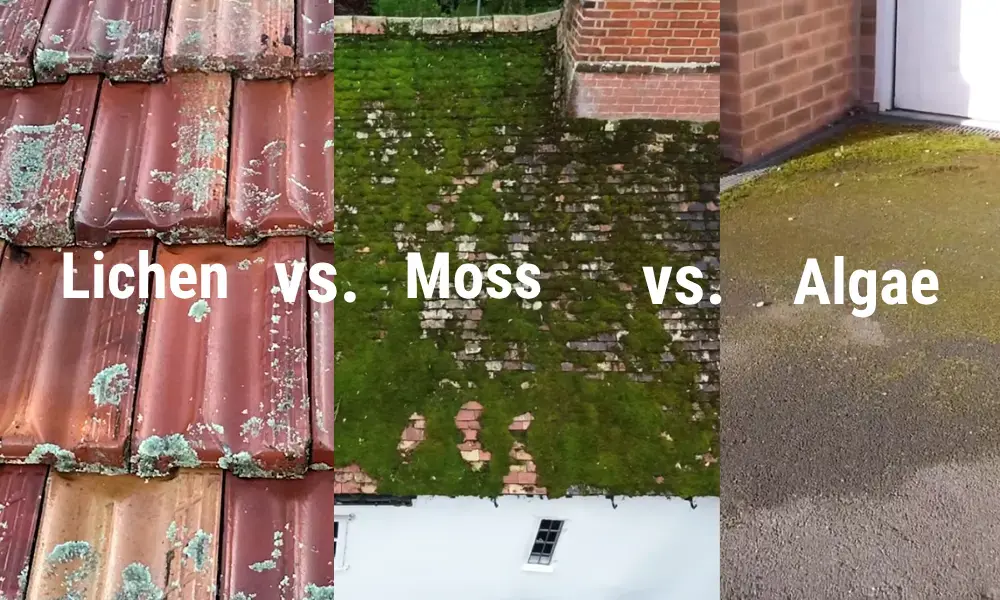 Moss · algae · lichen comparison
Moss is usually soft and raised, algae is usually a flat film or stain, and lichen is usually crusty, leafy, or branching. On Eugene properties, identifying the growth and the surface underneath it should come before choosing pressure washing, soft washing, or no cleaning at all.
- 40.8 inNormal annual Eugene precipitation cited by NWS climate data
- MossUsually raised, soft, leafy, and cushion-like
- AlgaeUsually flat, film-like, and slick when wet
- LichenOften crusty, lobed, flaky, or branching
That green growth on your roof, siding, driveway, fence, or patio may look like the same problem.
It usually isn’t.
Moss, algae, and lichen can grow within inches of each other, especially on damp exterior surfaces. Yet they are very different organisms. They also behave differently during cleaning.
That distinction matters in Eugene.
The combination of seasonal rain, tree cover, shade, and surfaces that stay damp creates favorable conditions for biological growth around many homes. National Weather Service climate data lists Eugene’s normal annual precipitation at about 40.8 inches, with much of that rain concentrated from fall through spring.
Oregon State University Extension also notes that Western Oregon’s mild, wet winters encourage moss growth. Moss commonly begins growing after fall rains and becomes most active by early spring.
So if your concrete turns green, your siding develops a film, or your roof starts growing thick green patches, you are seeing the effects of more than dirt.
The easiest way to tell moss vs. algae vs. lichen apart is to look at texture and growth pattern. Moss is usually soft and leafy. Algae looks more like a thin film or stain. Lichen usually appears crusty, leafy, or branching and often grips the surface tightly.
Correct identification helps you decide whether the growth needs removal and, more importantly, how the underlying surface should be cleaned. That surface-first approach is also how we handle pressure washing Eugene OR projects: identify the growth, identify the material, then choose the least aggressive effective method.
Moss vs. Algae vs. Lichen at a Glance
| Feature | Moss | Algae | Lichen |
|---|---|---|---|
| What is it? | Nonvascular plant | Group of photosynthetic organisms | Symbiotic organism dominated by fungus |
| Typical texture | Soft, fuzzy, springy | Slick or film-like | Crusty, leafy, scaly, or branching |
| Growth pattern | Mats, cushions, tufts | Films, stains, streaks | Crusts, lobes, flakes, branches |
| Common colors | Green to brown | Green, brown, dark gray | Gray, green, yellow, orange, black |
| Visible thickness | Usually raised | Usually flat | Flat or raised depending on type |
| Attachment | Often lifts in clumps | Coats the surface | Frequently attached very firmly |
| Common home surfaces | Roofs, concrete, brick, wood | Siding, concrete, fences, roofs | Stone, roofs, bark, masonry |
| Best clue | Tiny plant-like shoots | Flat discoloration | Distinct crust or structured thallus |
Identify first, clean second
Moss, algae, and lichen can share the same surface. The safest cleaning decision starts with the organism and the material underneath it, not with the highest available pressure.
Color alone is unreliable.
Green lichen exists. Moss can turn brown when dry. Algae may look dark instead of bright green. Some dark roof streaks aren’t technically algae at all.
Texture, structure, thickness, and attachment give you much better clues.
Why Are Moss and Algae So Common Around Eugene?
Moisture is the biggest part of the story.
Western Oregon provides exactly the type of seasonal environment that favors moss. OSU Extension describes Western Oregon winters as mild and wet and notes that moss performs particularly well in moist and shady conditions.
Around a home, several factors can make the problem worse:
- dense tree cover
- north-facing surfaces
- poor drainage
- clogged or overflowing gutters
- shaded concrete
- limited airflow
- accumulated leaves and organic debris
- roofs shaded by nearby trees
- fences that receive little direct sun
- siding below rooflines and vegetation
- areas hit repeatedly by irrigation
This is why two sides of the same Eugene house can look completely different.
A sunny south-facing wall may stay relatively clean while the shaded side develops green organic growth.
The same thing happens with driveways and walkways. One section dries quickly after rain. Another stays shaded beneath trees and remains damp much longer.
That extra moisture creates opportunity.
It also explains why simply removing visible growth doesn’t always solve the underlying problem. If the conditions remain favorable, moss or algae may eventually return.
What Is Moss?
Moss is a small nonvascular plant that commonly forms soft mats, tufts, or cushions. If the green growth looks like a tiny carpet sitting above the surface, moss is a strong possibility.
Get close and you may see hundreds of tiny leafy shoots.
Unlike most familiar garden plants, mosses don’t have true roots or the same vascular system used by larger plants to transport water.
They absorb moisture across much of their surface.
Moss also reproduces through spores rather than seeds.
When conditions become dry, some mosses may appear brown, brittle, or inactive. Moisture can make them green and flexible again.
Around Eugene homes, moss may appear on:
- asphalt shingles
- wood roofing
- concrete
- retaining walls
- pavers
- shaded brick
- stone
- tree bark
- decks
- fences
- lawns
OSU Extension guidance for the Willamette Valley identifies Dicranoweisia cirrata and Bryum capillare among common roof mosses in the region.
That is an especially useful local detail.
The green material on an Oregon roof is not necessarily generic “roof grime.” It can be an established plant colony responding to the moisture and shade around the property.
How can you recognize moss?
Look from the side.
Moss generally has visible depth. Instead of merely changing the color of the surface, it grows above it.
You may notice:
- soft cushions
- dense green mats
- tiny leafy shoots
- velvety texture
- clumps that partially lift from the surface
Think tiny carpet, not stain.
What Is Algae?
Outdoor algae usually appears as a flat green, brown, or dark coating rather than a raised plant-like mat.
If moss resembles carpet, algae is closer to paint or film.
You may see algae on:
- siding
- concrete walkways
- driveways
- patio surfaces
- fencing
- exterior trim
- shaded walls
- damp masonry
Algae benefits from persistent surface moisture.
A section of siding shaded by trees may gradually develop a green haze. Concrete may turn green where rainwater drains poorly. Fence panels surrounded by vegetation may stay damp long enough for a visible film to develop.
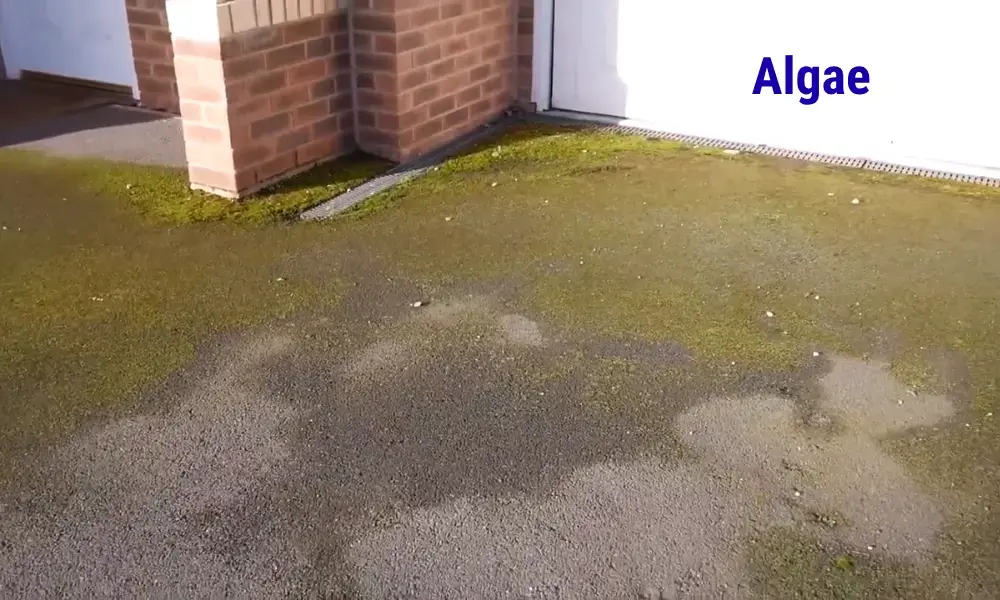
When wet, algae-covered hard surfaces may become slippery.
That is why growth on steps, walkways, patios, and other traffic areas can become more than an appearance problem.
What about black streaks on roofs?
Roof terminology becomes a little confusing here.
The dark streaking commonly called “roof algae” is often associated with Gloeocapsa magma, which is actually a cyanobacterium.
Homeowners and the roofing industry commonly continue to use the term algae.
For practical identification, concentrate on the growth pattern.
Flat discoloration or streaking points more toward algae or cyanobacterial growth. Raised green cushions point more toward moss.
What Is Lichen?
Lichen is a biological partnership involving a fungus and a photosynthetic partner, usually an alga or cyanobacterium.
It doesn’t look exactly like moss or ordinary algae because the partnership creates its own body structure, known as a thallus.
Lichens can survive on:
- rocks
- tree bark
- masonry
- stone
- roofing
- old wood
- other exposed surfaces
Their colors vary enormously.
Gray is common, but lichen can also appear green, yellow, orange, brown, or black.
Three visible growth forms make identification easier.
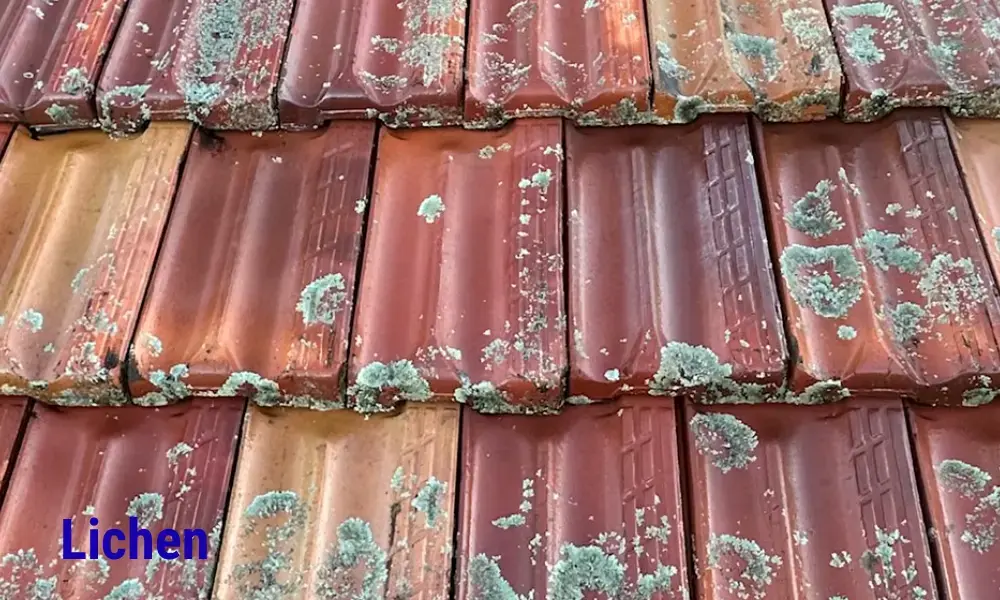
Crustose lichen
Crustose lichen forms a thin crust attached closely to the surface.
It may resemble dried paint, mineral staining, or a cracked patch.
It can be extremely difficult to separate from stone or another substrate.
Foliose lichen
Foliose lichen forms flatter, leaf-like lobes.
Its edges may curl upward from the surface.
Some green foliose lichens can easily be mistaken for moss from several feet away.
Fruticose lichen
Fruticose lichen has more obvious three-dimensional growth.
It may resemble small branches, hairs, or miniature shrubs.
The main lesson is simple.
Do not identify lichen by color. Identify it by structure.
How Can You Identify Moss vs. Algae vs. Lichen in About 60 Seconds?
You usually don’t need laboratory equipment.
Use four clues.
1. Look at the growth from the side
Is it actually raised above the surface?
Moss usually is.
Algae normally remains flat.
Some lichen is flat, while foliose and fruticose lichens produce more obvious three-dimensional structures.
2. Examine the texture
When the area can be touched safely:
Soft and springy: probably moss.
Slick or film-like: probably algae.
Crusty, leathery, flaky, or branching: probably lichen.
Do not climb onto a wet roof to perform this test.
Use close-up photography or binoculars if the growth is above ground level.
3. Look for tiny structures
A basic hand lens can be surprisingly useful.
Moss often reveals tiny leaf-like structures along small shoots.
Algae lacks those miniature leaves.
Lichen may reveal lobes, branching structures, small discs, cups, or a cracked crust.
4. Check how tightly it is attached
Moss may lift in a clump.
Algae generally behaves more like a coating.
Lichen, especially crustose lichen, may appear almost fused to the underlying material.
Those four observations are considerably more reliable than asking whether the growth is “green.”
What Is the Difference Between Moss and Lichen?
Moss is a plant. Lichen is a symbiotic organism.
That is the biological answer.
The practical answer is even easier.
Moss usually looks soft.
Lichen usually looks structured.
A moss colony may resemble a tiny green landscape growing above a roof, wall, rock, or paver.
Lichen may resemble dried paint, leaves pressed against the surface, flakes, or tiny branches.
There is one complication.
They can grow together.
A shaded exterior surface can support moss, algae, and lichen at the same time.
So you do not always have to choose one answer for the entire area.
Examine separate patches.
Is Moss Basically Mold?
No.
Moss is a plant. Mold is fungal growth.
They are commonly confused because both are associated with moisture.
Their appearance is different too.
Moss normally forms visible plant-like structures.
Mold is more likely to look fuzzy, powdery, dusty, or cotton-like.
Finding moss on the exterior of a Eugene home does not automatically mean there is an indoor mold problem.
However, repeated biological growth can still tell you something useful about the environment.
If one area remains persistently wet, check:
- drainage
- gutters
- downspouts
- leaks
- irrigation
- tree cover
- shade
- ventilation
- surface condition
The growth may be the visible symptom of a moisture pattern.
Which Growth Causes the Most Problems?
There is no single answer.
The surface underneath the organism matters as much as the organism itself.
Algae on a concrete walkway may create a slipping concern.
Moss on a roof presents different maintenance concerns.
Lichen on healthy tree bark may need no treatment whatsoever.
This is one of the most important principles in professional exterior cleaning.
The question should not simply be:
“How do we remove this?”
The better questions are:
What is growing here?
What surface is underneath it?
What cleaning process can that surface safely tolerate?
That distinction separates surface cleaning from simply blasting visible growth away.
-
Durable hard surfaces
Pressure washing
Useful when controlled mechanical force is appropriate, especially on suitable concrete and hardscape.
-
Sensitive surfaces
Soft washing
Uses lower pressure with surface-compatible cleaning chemistry for siding, roofs, and other materials that can be damaged by aggressive pressure.
Can You Pressure Wash Moss, Algae, and Lichen?
Sometimes pressure is useful.
Sometimes it is completely inappropriate.
The material underneath determines the answer.
Concrete driveways and walkways
Concrete is one of the exterior surfaces where professional pressure washing may be appropriate.
Even here, cleaning should not mean automatically using maximum pressure.
The condition and age of the concrete matter. So do stains, biological growth, previous coatings, cracks, and nearby landscaping.
Professional concrete cleaning combines appropriate equipment, pressure, technique, and cleaning products for the condition of the surface.
This is why a green driveway should first be evaluated as concrete with organic growth, not merely “something dirty that needs more pressure.”
House siding
Siding usually requires a more controlled approach.
High pressure can force water where it should not go and may damage some siding materials, finishes, trim, seals, or painted surfaces.
For many house washing in Eugene situations, the cleaning solution and dwell time perform much of the work while water is used at lower pressure.
That is one reason understanding soft washing in Eugene and when to use pressure matters.
The goal is to remove contamination without creating unnecessary damage.
Asphalt shingle roofs
Never treat a shingle roof like concrete
Asphalt roofing guidance warns against power washing. The cleaning method should protect the shingle surface while addressing moss, lichen, or dark biological staining.
This is where the rule becomes much clearer.
Do not pressure wash asphalt shingles.
The Asphalt Roofing Manufacturers Association warns against power washing asphalt roofs because high-pressure systems can damage the roofing material. ARMA also advises against brushes and brooms for algae cleaning.
Roof manufacturer IKO similarly warns that pressure washing can remove protective granules, disturb shingles, and contribute to leaks.
That means roof cleaning in Eugene should never be treated like driveway cleaning.
A contractor who understands exterior surfaces should know when not to use the pressure washer.
Wood surfaces
Decks and fences require another approach.
Wood species, age, coatings, condition, grain, previous cleaning, and desired finish all matter.
Excessive pressure can damage wood fibers and leave visible cleaning marks.
Again, cleaning strength should match the substrate.
Why Moss on Eugene Roofs Deserves Special Attention
Roof moss deserves its own discussion because it is so closely connected with Pacific Northwest conditions.
OSU Extension describes roof moss as a common problem in the moist Pacific Northwest.
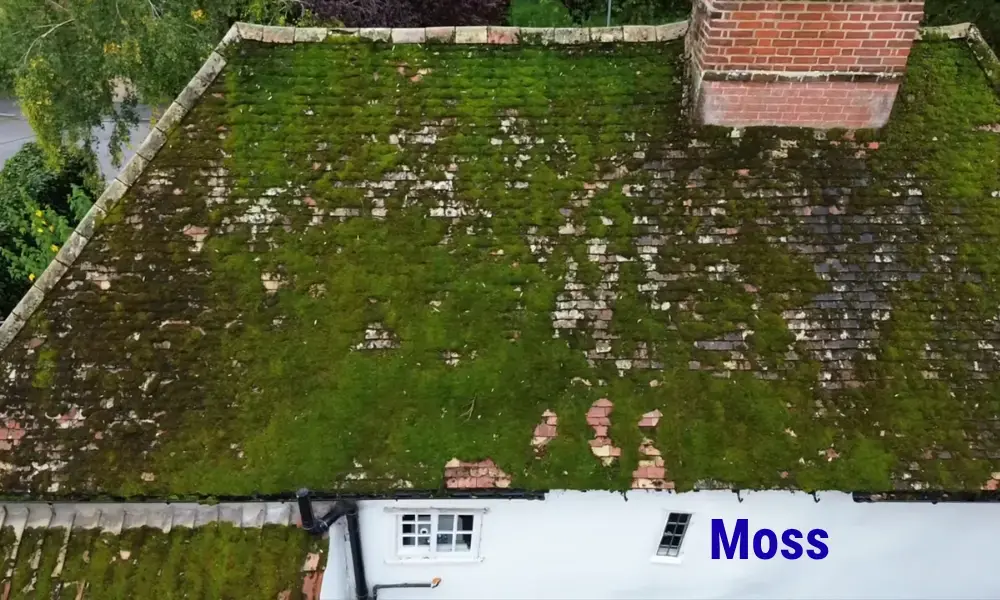
Moss can collect debris and help areas stay wet longer.
On some roofing systems, established growth may also interfere with normal drainage or lift material.
OSU guidance for the Willamette Valley specifically identifies moss species commonly found on roofs and explains how retained debris can lengthen the amount of time a roof stays wet.
That does not mean the solution is aggressive pressure.
Quite the opposite.
Asphalt roofing requires particularly careful treatment.
If you’re looking at:
- thick moss cushions
- lifted shingles
- widespread dark streaks
- extensive lichen
- heavy tree coverage
- areas that remain damp
the condition should be evaluated before deciding how to clean it.
Roof safety matters too.
Wet moss and algae make roofs exceptionally slippery. Working at height adds another serious risk.
What About Moss and Algae on Eugene Concrete?
Driveways, patios, walkways, and steps tell a different story.
Concrete is porous.
Shade, moisture, leaves, soil, nearby vegetation, and poor drainage can contribute to visible biological growth.
A shaded walkway may develop green material much faster than exposed concrete a few feet away.
This is common in the Pacific Northwest. OSU Extension specifically describes moss as a common issue on pavement during periods of higher precipitation. If your slab is already green, our guide explains why Eugene driveways turn green and what the buildup usually means.
Cleaning can improve more than appearance. If you are deciding whether an older slab needs cleaning or a larger repair, compare concrete cleaning vs. resurfacing before assuming the concrete itself has failed.
Removing slippery organic buildup from walking surfaces may also improve traction.
However, long-term control often requires looking beyond cleaning.
If a section remains constantly shaded and wet, the same environment that supported the original growth remains in place.
That is why good exterior maintenance combines cleaning with prevention.
Why Does Moss or Algae Keep Coming Back After Cleaning?
Because cleaning removes the growth.
It doesn’t change Eugene’s climate.
Nor does it automatically change the microclimate around your house.
OSU Extension makes this point clearly in its moss-management guidance: control will not last if environmental conditions continue favoring moss.
Around a home, recurring growth may be encouraged by:
Heavy shade
Tree cover can keep roofs, siding, concrete, and fences damp longer after rain.
Poor drainage
Standing water or slowly drying surfaces create better conditions for biological growth.
Gutters and downspouts
Overflowing gutters may repeatedly wet siding, fascia, walkways, or landscaping.
Nearby vegetation
Dense shrubs and trees can reduce airflow and shade exterior surfaces.
Organic debris
Leaves, needles, dirt, and other debris can retain moisture.
Surface orientation
Some sides of a house receive less direct sunlight than others.
Cleaning still matters.
But understanding why the surface became dirty helps you make better decisions about how frequently it may need maintenance.
Does Moss Always Grow on the North Side?
No.
This is one of the oldest moss myths.
A north-facing surface may receive less direct sunlight in many Northern Hemisphere locations, allowing it to stay damp longer.
That can favor moss.
But direction is only one environmental factor.
A south-facing wall shaded by dense trees may stay wetter than a north-facing wall exposed to afternoon sun.
Buildings, trees, slopes, drainage, wind, irrigation, and surface texture all affect moisture.
So do not use moss as a compass.
Use it as a clue about the local microclimate.
How Can You Tell Moss From Lichen on a Tree?
Tree bark is another place where people commonly make the wrong diagnosis.
Moss generally forms soft green mats or cushions.
Lichen forms crusty patches, leaf-like lobes, or branching structures.
More importantly, lichen growing on tree bark does not automatically mean the tree is diseased.
Common bark lichens generally use the tree as a surface rather than feeding from it like a parasite.
That means scrubbing lichen from healthy living bark is usually unnecessary.
If a tree looks unhealthy, investigate the actual symptoms:
- dead limbs
- weak leaf growth
- decay
- cracks
- canopy thinning
- root damage
- drought stress
Do not blame the lichen simply because it is easy to see.
Should Lichen Always Be Removed?
No.
The answer depends entirely on where it is growing.
Lichen on a tree may be harmless.
Lichen on decorative stone may be aesthetically desirable.
Lichen on roofing or another building surface may require evaluation.
This is another reason one-size-fits-all cleaning advice is unreliable.
A roof is not a driveway.
A driveway is not cedar siding.
Cedar siding is not a tree.
A historic stone surface is not ordinary concrete.
The safest cleaning method starts with identifying both the growth and the material underneath it.
What Is Soft Washing and How Is It Different From Pressure Washing?
The terms are often used interchangeably by homeowners, but they describe different approaches.
Pressure washing relies more heavily on mechanical water pressure to remove contamination.
That can work well on suitable durable surfaces such as certain concrete applications.
Soft washing relies on lower water pressure combined with an appropriate cleaning process to break down organic growth.
This approach may be more appropriate for surfaces where excessive pressure creates unnecessary risk.
Neither method is automatically “better.”
The correct method depends on:
- surface material
- surface condition
- type of contamination
- surrounding landscaping
- coatings and finishes
- manufacturer recommendations
- access
- safety concerns
Professional exterior cleaning should therefore be surface-specific.
The machine is only one part of the process.
A Simple Exterior Growth Inspection Checklist
Before cleaning a green, gray, brown, or black patch around your home, answer these questions:
- Is the growth flat or raised?
- Does it feel soft, slick, crusty, or leathery?
- Can you see tiny plant-like shoots?
- Can you see lobes, scales, discs, or branches?
- Does the material lift easily?
- Is the area shaded?
- Does it remain wet longer than surrounding surfaces?
- What material is underneath it?
- Are several types of growth present?
- Could aggressive cleaning damage the surface?
The last question is the most important.
Getting organic growth off the property is not a successful cleaning job if the cleaning process damages the property underneath it.
Common Moss, Algae, and Lichen Cleaning Mistakes
Mistake 1: Calling every green patch moss
Flat green contamination may be algae.
Hard green crusting may be lichen.
Look at structure first.
Mistake 2: Assuming more pressure means better cleaning
It doesn’t.
Increasing pressure may make some surfaces look cleaner quickly while increasing the possibility of surface damage.
The goal is appropriate pressure, not maximum pressure.
Mistake 3: Pressure washing asphalt shingles
Roofing manufacturers and industry guidance specifically warn against this practice.
Mistake 4: Treating every exterior material the same
Concrete, wood, painted siding, vinyl, masonry, roofing, and natural stone have different cleaning requirements.
Mistake 5: Ignoring the cause of recurring growth
If shade, drainage, vegetation, or persistent moisture remains unchanged, biological growth may return.
Mistake 6: Assuming every black roof streak is mold
Dark roof discoloration may instead involve cyanobacterial growth commonly called roof algae.
Mistake 7: Removing harmless lichen from trees
Visible lichen is not automatically evidence of tree disease.
Identification should happen before treatment.
Moss, Algae & Lichen FAQs
How can I tell if something is moss or lichen?
Moss usually looks like a soft miniature carpet with tiny plant-like shoots. Lichen tends to look crusty, flaky, leafy, or branching. Moss can often lift in a small clump, while crustose lichen may be firmly bonded to the surface.
What is the difference between moss and lichen?
Moss is a nonvascular plant. Lichen is a symbiotic organism involving a fungal partner and a photosynthetic partner. Moss normally feels soft and springy. Lichen is more likely to feel crusty, leathery, flaky, or structured.
Is moss algae or fungus?
Neither.
Moss is a plant.
Is moss basically mold?
No. Mold is fungal growth. Moss is a plant. Both may appear where moisture is present, which causes much of the confusion.
Why is there so much moss around Eugene?
Western Oregon’s mild, wet winters create favorable conditions for moss, particularly on shaded, moist surfaces. OSU Extension notes that moss growth in Western Oregon typically begins with fall rains and becomes strongest by early spring.
Why does my north-facing siding turn green?
North-facing areas often receive less direct sunlight and may stay damp longer. Shade from trees and surrounding buildings can make the effect stronger. Flat green growth on siding is commonly more consistent with algae than raised moss.
Why does moss grow on my Eugene driveway?
Moisture, shade, accumulated debris, and poor drainage can create favorable conditions. Pacific Northwest pavement is particularly susceptible during wetter periods.
Can algae make concrete slippery?
Yes. Wet biological films can reduce traction on walkways, patios, steps, and other hard surfaces.
Can lichen be green?
Yes. Lichen comes in many colors, including green, gray, yellow, orange, brown, and black. Texture and structure are more useful identification clues than color.
Does moss growing on trees tell you north?
Not reliably. Direction can influence sunlight, but shade, moisture, drainage, vegetation, and nearby structures matter too.
Is lichen harmful to trees?
Common lichen growing on bark generally uses the tree as a place to live rather than feeding from it. A tree that appears unhealthy should be evaluated for its actual symptoms instead of assuming lichen caused the decline.
Can you pressure wash moss from an asphalt roof?
No. Asphalt roofing industry guidance warns against pressure washing shingles because high pressure can damage the roofing surface.
Should you pressure wash algae from siding?
Not automatically. Siding material, condition, coatings, openings, and manufacturer guidance should determine the cleaning method. Many house-washing situations benefit from lower pressure rather than aggressive spraying.
Can moss, algae, and lichen grow together?
Yes.
A single damp surface may support two or all three. Examine individual patches rather than assuming every area contains the same organism.
What kills moss or lichen naturally?
There is no universal home remedy that is safe for every exterior surface. Sunlight, improved drainage, reduced moisture, and better airflow may make an area less favorable for growth. Actual removal methods should be matched to the material.
The Easiest Way to Remember Moss vs. Algae vs. Lichen
Forget color.
Remember texture.
Moss is the tiny carpet.
Algae is the thin film.
Lichen is the crust, leaf, or miniature branch.
That simple rule can identify a surprising amount of biological growth around an Eugene property.
Then comes the part that matters for exterior cleaning.
Identify the surface underneath it.
Concrete may tolerate a cleaning approach that would be completely wrong for siding.
Wood requires different judgment.
Asphalt shingles should not be pressure washed.
Tree lichen may need no removal at all.
Good exterior cleaning is not about pointing the strongest machine at every stain.
It is about understanding what is growing, why it is growing, what surface it is growing on, and which cleaning method can remove the contamination without unnecessary damage.
For Eugene homeowners, that distinction is especially useful. Our wet Pacific Northwest conditions mean moss and algae are likely to remain part of exterior property maintenance.
Identify first.
Choose the cleaning process second.
And treat the surface underneath the growth as the thing you’re actually trying to protect.
Clean the Growth Without Sacrificing the Surface
Moss, algae, and lichen do not all need the same treatment. We inspect the surface first and choose a cleaning method appropriate for concrete, siding, roofing, wood, or other exterior materials.
Evergreen Surface Care provides pressure washing Eugene OR homeowners can match to the actual surface and type of buildup.