
Wildfire Safety Guide · Eugene, Oregon
Wildfire Ash Cleanup Eugene: What Homeowners Should Do Before Cleaning
Wildfire ash cleanup Eugene: start with particle control, not high pressure. After wildfire smoke moves through the Willamette Valley, here is how to control ash before cleaning the surface underneath.
First response
Control the ash before cleaning the surface.
- Check current air quality.
- Identify whether structures burned nearby.
- Dampen loose ash gently.
- Keep ash and rinse water out of storm drains.
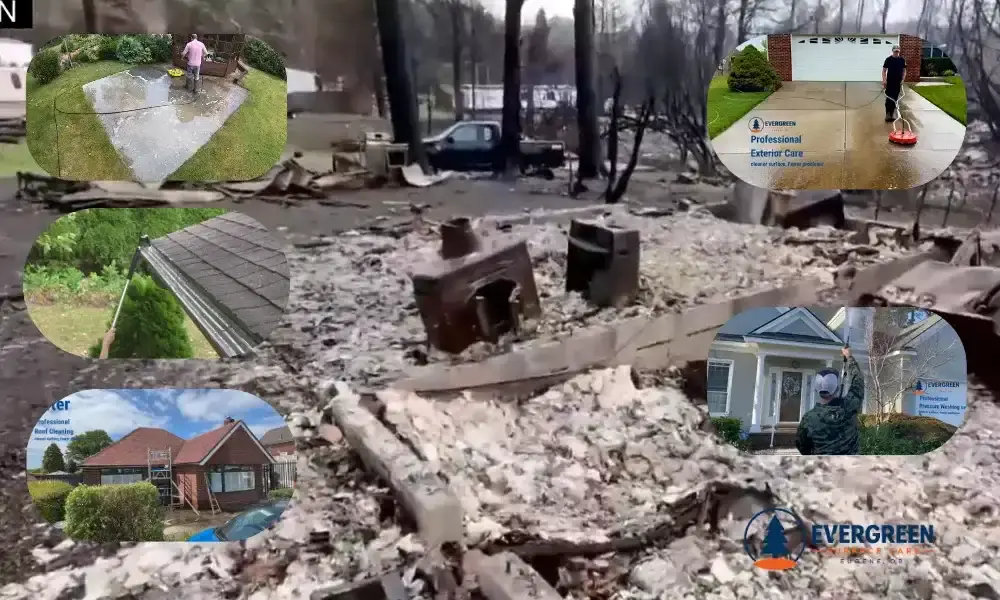
Quick answer
Wildfire ash cleanup Eugene: do not start by pressure washing dry ash. Check the air, control loose particles with gentle dampening, keep runoff out of storm drains, and only then decide what normal exterior cleaning the underlying surface needs.
Wildfire ash cleanup Eugene: the safest approach starts with one rule. Control the ash before using normal exterior-cleaning methods. A thin gray film on siding, windows, decks, driveways, or patios can look like ordinary dust.
After wildfire smoke moves through the Willamette Valley, it may not be ordinary dust.
Wildfire ash can settle on roofs, gutters, siding, outdoor furniture, vehicles, concrete, plants, and other exposed surfaces. The natural reaction is understandable. Grab the hose or pressure washer and clean everything before the ash gets tracked indoors.
That is not always the safest first move.
The Oregon Department of Environmental Quality advises people cleaning outdoor wildfire ash to gently dampen it first. DEQ specifically warns against starting with a pressure washer because the force can disturb dry ash before the water wets it. Leaf blowers, dry sweeping, and ordinary shop vacuums can also send fine particles back into the air.
For Eugene homeowners, the safest approach is simple:
Check the air first. Identify what kind of ash you are dealing with. Keep it from becoming airborne. Keep contaminated water out of storm drains. Then decide whether normal exterior cleaning is appropriate.
That order matters.
Is Wildfire Ash on a House Dangerous?
Wildfire ash should be treated carefully because disturbing it can put small particles back into the air.
The exact risk depends partly on what burned.
Ash from trees, brush, grass, and other vegetation is different from ash created when houses, sheds, vehicles, plastics, paint, insulation, electronics, chemicals, and other manufactured materials burn.
The U.S. Environmental Protection Agency notes that ash from burned structures can be more hazardous than ash from natural vegetation. EPA still recommends limiting exposure to wildfire ash regardless of its source.
Oregon DEQ gives an even stronger warning for burned structures. Fire debris can contain substances such as asbestos, lead, mercury, cadmium, chromium, and other hazardous materials.
That creates an important distinction for Eugene homeowners.
Light ash carried into Eugene by distant smoke
A light dusting that settled on an otherwise undamaged home may often be handled with careful dust-control methods once outdoor air quality improves.
Ash from a nearby burned building or damaged property
This is not an ordinary exterior-cleaning job.
If your house, a neighboring building, garage, shed, vehicle, or other structure burned, do not assume the residue is harmless wood ash. Oregon DEQ recommends additional precautions for fire debris and strongly emphasizes asbestos and hazardous-material concerns.
If you are unsure which situation applies, take the more cautious route.
Guidance source: Oregon DEQ
Should You Pressure Wash Wildfire Ash Off Your House?
Do not start by pressure washing dry wildfire ash.
This is one of the most important points in this guide.
Oregon DEQ tells residents cleaning ash outdoors to gently dampen the ash first and specifically advises against using a pressure washer because it can generate dust before the ash becomes wet.
That may sound strange coming from an exterior-cleaning company.
Pressure washing is useful for many things. Concrete, certain masonry surfaces, and other durable materials can respond very well to controlled pressure.
Dry wildfire ash is different.
Pressure is not the first problem you need to solve. Particle control is.
A powerful water stream striking a dry surface can disturb material around the spray pattern before the surface is fully saturated. You do not want a cleaning method that turns settled ash back into airborne ash.
Think of the process in two stages.
Stage one: safely control and remove the ash.
Stage two: clean whatever ordinary dirt, staining, algae, soot film, or residue remains after the ash hazard has been addressed.
Those are not automatically the same job.
Guidance source: Oregon DEQ ash cleanup guidance
Wildfire Ash Cleanup Eugene: What Should Homeowners Do Before Cleaning?
Before touching the siding or rolling out a hose, work through these steps.
Wildfire Ash Cleanup Eugene Step 1: Check Local Air Quality
Do not begin outdoor cleanup just because the sky looks clearer.
Smoke concentrations can change during the day. Oregon Health Authority recommends monitoring current conditions because wildfire smoke levels can change quickly.
Lane County directs residents to Lane Regional Air Protection Agency resources for local air-quality information. Oregon DEQ also provides its AQI system and the OregonAIR app.
If the air is still smoky or unhealthy, exterior cleanup can usually wait.
Ash sitting quietly on a surface is generally less likely to enter your lungs than ash you disturb while working.
2. Determine whether a structure burned nearby
Look beyond your own property.
Did a nearby house, shed, commercial building, vehicle, or other manufactured structure burn?
Is there heavy debris rather than a light layer of windblown ash?
Was your property directly affected by fire?
If so, normal house washing or driveway cleaning should not be your first step.
Burned-building ash can contain hazardous contaminants. Oregon DEQ also has specific requirements and recommendations concerning asbestos and debris disposal after structural fires.
3. Keep children and pets away
Children should not participate in wildfire ash cleanup.
EPA and Oregon DEQ both recommend keeping children away from ash while cleanup is underway. Pets should also be kept away from contaminated areas until surfaces have been cleaned.
That includes patios, decks, play structures, outdoor furniture, and walkways where ash has accumulated.
4. Protect yourself
For cleanup in an ash-covered area, EPA recommends a properly fitting NIOSH-approved N95 or P100 respirator along with gloves and clothing that limits skin contact. CDC also recommends eye protection during wildfire cleanup.
A loose paper or surgical mask is not equivalent to a properly fitting respirator for ash particles.
After working around ash, avoid carrying residue inside on your shoes or clothing.
5. Close doors and windows
If you are cleaning outside, you do not want disturbed material entering the house.
Keep windows and doors closed during exterior cleanup. Pay particular attention to nearby doors, open garage bays, fresh-air intakes, and other openings.
EPA recommends using recirculation settings and filtration during wildfire smoke events to reduce outdoor particle entry.
Guidance source: Oregon Health Authority
What Is the Safest Way to Remove Light Wildfire Ash Outdoors?
For a light deposit of windblown ash on a home that was not directly burned, the goal is to remove the material without turning it into a cloud. For wildfire ash cleanup Eugene homeowners should prioritize dust control, runoff control, and low-force removal before routine washing.
A useful rule is:
Wet gently. Move slowly. Use low force.
Oregon guidance has used essentially the same principle for ash cleanup.
Step 1: Wait for better air
Start only after smoke conditions improve enough for outdoor work.
Step 2: Wear appropriate protection
Use gloves, protective clothing, and a properly fitting respirator when appropriate.
Step 3: Lightly mist the ash
The goal is to suppress dust.
Do not flood it.
EPA recommends using as little water as practical when wetting ash.
Step 4: Collect heavier deposits
Where ash is thick enough to gather, gently scoop or sweep the dampened material rather than flushing everything across the property.
A HEPA-equipped vacuum may be appropriate for some dusty surfaces. Ordinary shop vacuums and household vacuums can return fine material to the air and should not be used for ash unless they are designed with suitable HEPA filtration.
Step 5: Control rinse water
This is where a lot of otherwise careful cleanup goes wrong.
Do not simply hose the ash toward the curb.
Oregon DEQ says ash and debris should not be washed into streets, storm drains, or surface waters. Where appropriate, wash water can be directed toward vegetated areas where soil and plants can help filter suspended material.
Step 6: Clean the remaining surface appropriately
Only after the loose ash has been controlled should you evaluate the actual surface underneath.
At that point, the correct method depends on whether you are dealing with vinyl siding, painted wood, cedar, concrete, pavers, roofing, gutters, or another material.
That is where normal exterior-cleaning knowledge becomes useful again.
Guidance source: Oregon DEQ
Can You Hose Wildfire Ash Off Siding?
A gentle rinse may be appropriate for light windblown ash after conditions are safe and the ash has been controlled.
But do not treat every wall the same.
Vinyl siding, fiber cement, painted wood, cedar, stucco, brick, and aluminum all respond differently to water and cleaning solutions.
Dry ash can also contain fine grit. Aggressive scrubbing can grind that material across finished surfaces.
Start with the least aggressive method that works.
For a typical Eugene house, that usually means controlled wetting followed by a gentle rinse rather than immediately blasting the siding.
Once the wildfire residue has been safely removed, ordinary algae, mildew, pollen, and grime can be addressed with a surface-appropriate house washing method.
For delicate siding, that often means soft washing rather than high-pressure cleaning.
What About Wildfire Ash on a Roof?
Roofs deserve extra caution.
First, walking on a roof carries a fall risk even in perfect conditions. Ash can make surfaces more slippery.
Second, adding large amounts of water to accumulated material is not something to do casually.
Oregon State University emergency guidance warns against excessively wetting heavy ash deposits on roofs and also notes the additional slipping danger ash creates on roofs and ladders.
For ordinary asphalt shingles, high pressure is already the wrong cleaning method. A wildfire ash event does not change that.
If your roof has only a light dusting from distant smoke, it may be better to avoid unnecessary roof traffic and evaluate the condition after the air clears.
If the roof has heavy ash, debris, heat damage, burned materials, or contamination from a nearby structural fire, treat the situation as fire recovery rather than routine roof cleaning.
What About Ash Inside the Gutters?
Gutters can collect ash because the roof funnels loose material toward the eaves.
Do not immediately flush a concentrated layer of ash through the downspouts and into the stormwater system.
Oregon DEQ advises keeping ash-contaminated water out of storm drains and surface waters.
For heavier accumulation, collecting dampened material before rinsing may provide better control.
This matters even more in Eugene because wildfire season can run straight into the beginning of the wetter fall period.
Ash mixed with fir needles, maple leaves, moss fragments, and other roof debris can create a mess once rain begins moving everything toward the downspouts.
After wildfire residue has been safely handled, routine gutter cleaning can address the normal organic debris.
How Should You Handle Ash on Driveways and Sidewalks?
Concrete makes people want to reach for the pressure washer immediately.
Resist that impulse while the ash is dry.
Start by controlling the ash itself.
Lightly dampen it. Collect larger deposits. Keep runoff away from storm drains. Then evaluate what remains.
Once the loose ash is removed, normal driveway cleaning may be appropriate for oil stains, moss, algae, tire marks, or embedded grime that was already present before the smoke event.
The difference is timing.
You are not using pressure as the initial ash-control method. You are using normal concrete-cleaning methods after the wildfire residue has been safely addressed.
What About Patios, Pavers, and Natural Stone?
Pavers introduce another concern.
Aggressive pressure can remove joint sand even during ordinary patio cleaning.
Add fine wildfire ash to the equation and a careless cleaning job can spread gray slurry across the patio while stripping material from the joints.
Begin with gentle ash control.
After the loose material is gone, inspect the joints and stone surface before deciding whether further patio cleaning is needed.
Natural stone also varies widely in hardness and porosity. A method suitable for concrete may be wrong for softer or more porous stone.
Wildfire season is not the time to solve every stain with more pressure.
Should You Use a Leaf Blower on Wildfire Ash?
No.
This is one of the clearest points across public-health guidance.
Leaf blowers put settled ash directly back into the air.
Oregon DEQ, EPA, and Oregon State University guidance all advise against using leaf blowers for wildfire ash cleanup.
A blower may make the driveway look clean in five minutes.
It does that by moving the problem into the air and onto neighboring properties.
That is not cleaning.
Can You Use a Shop Vacuum?
Not an ordinary one.
Regular household or shop vacuums may exhaust fine ash back into the surrounding air.
EPA and Oregon DEQ recommend HEPA-type filtration when vacuuming ash.
If you do not have appropriate equipment, dampening and carefully collecting the ash is generally preferable to running a conventional shop vacuum across it.
Can Wildfire Ash Go Down a Storm Drain?
Avoid it.
This point is especially important when cleaning roofs, gutters, driveways, sidewalks, and patios.
Oregon DEQ warns that rain and cleanup water can carry ash, sediment, and pollutants into rivers and streams. Its post-fire guidance tells homeowners not to hose ash into streets or storm drains.
Before using water, look at where that water will go.
If the answer is “straight down the curb and into the drain,” change the plan.
For wildfire ash cleanup Eugene properties, runoff control should be part of the cleanup setup, not something you think about after the washing starts.
Guidance source: Oregon DEQ runoff guidance
When Should You Leave Wildfire Ash Alone?
Sometimes doing nothing for the moment is the better decision.
Oregon State University Extension notes that a thin dusting of ash on plants may not require immediate removal. It also recommends waiting until air quality reaches healthy levels before beginning cleanup.
The same principle applies more broadly.
If:
- the air is still smoky
- ash is continuing to fall
- wind is picking material back up
- you do not have proper protective equipment
- runoff cannot be controlled
- you suspect structural-fire debris
- the property itself was burned
then this may not be the right time for ordinary exterior cleaning.
Cleaning tomorrow is usually better than creating another exposure today.
When Is Professional Exterior Cleaning Appropriate?
Wildfire ash cleanup Eugene: professional exterior cleaning can make sense after the ash itself has been assessed and safely controlled.
For example, a Eugene home may have had months of algae growth before wildfire smoke arrived. Once the ash is removed, the siding may still need normal house washing.
A driveway may still have oil spots, black organic buildup, and moss after loose ash is gone.
A roof may already have moss or black algae staining unrelated to the fire.
Those are normal exterior-cleaning problems.
The key is not confusing them with wildfire remediation.
Evergreen Surface Care provides pressure washing and soft washing for routine exterior buildup in Eugene. We match the cleaning method to the material instead of using high pressure everywhere.
We do not treat potentially hazardous structural-fire ash as an ordinary pressure-washing problem.
If a burned structure is involved, public-agency guidance and appropriate remediation requirements come first.
Wildfire Ash vs. Normal Eugene Exterior Buildup
The difference is worth understanding.
| What you see | Likely concern | First response |
|---|---|---|
| Fine gray ash after a smoke event | Airborne particle exposure | Check AQI and control ash gently |
| Green film on shaded siding | Algae or organic growth | House washing or soft washing |
| Green moss on roof | Moss growth | Roof-safe treatment |
| Black streaks on shingles | Often organic roof staining | Roof evaluation and soft washing |
| Fir needles and leaves in gutters | Organic debris | Gutter cleaning |
| Moss on concrete | Wet-climate organic growth | Surface-appropriate concrete cleaning |
| Heavy ash beside a burned structure | Possible hazardous fire debris | Follow fire-recovery guidance |
The first column may look similar from twenty feet away.
The correct response is not always similar.
What Should You Do With Ash on Plants and Landscaping?
Do not automatically blast plants clean.
Oregon State University Extension says a thin layer of ash on plants does not always need immediate removal. Heavier deposits around high-use areas, food-producing plants, valuable plants, windows, doors, and air intakes deserve more attention.
When rinsing is appropriate, use gentle water.
Avoid creating clouds of dust.
Also remember that landscaping can help filter small amounts of appropriately directed wash water, while storm drains bypass that filtering step and carry runoff toward local waterways.
Guidance source: OSU Extension
Should You Clean While Wildfire Smoke Is Still in Eugene?
Usually not if the work can wait.
During smoke events, Oregon health officials recommend reducing outdoor activity and checking current air-quality information.
In July 2026, Oregon Health Authority again warned residents about wildfire-smoke exposure as wildfire activity intensified across the state. State emergency officials said on August 28 that statewide coordination needs had eased, but they also stressed that Oregon remained dry and wildfire potential continued.
That distinction matters.
A quieter fire day does not mean wildfire season is over.
For Eugene and Lane County homeowners, it makes sense to keep an eye on current local conditions rather than using a fixed calendar date to decide when outdoor cleanup is safe.
Wildfire Ash Cleanup Eugene Checklist: Before, During, and After
Before cleaning:
- Check local air quality.
- Confirm ash is no longer actively falling.
- Determine whether any structure burned nearby.
- Keep children and pets away.
- Close nearby doors and windows.
- Wear appropriate protective equipment.
- Identify storm drains and runoff paths.
- Avoid leaf blowers.
- Avoid ordinary shop vacuums.
- Do not start by pressure washing dry ash.
During cleanup:
- Lightly dampen loose ash.
- Use as little water as practical.
- Move slowly.
- Collect heavier material where possible.
- Keep contaminated water away from storm drains.
- Avoid aggressive scrubbing on finished surfaces.
- Stop if the work starts producing airborne dust.
After the ash is gone:
- Inspect siding and paint.
- Check gutters and downspouts.
- Look at the roof from the ground when possible.
- Check patios, walkways, and driveways.
- Replace or inspect dirty HVAC filters if smoke entered the home.
- Decide whether normal exterior cleaning is still needed.
Wildfire Ash Cleanup Eugene FAQs
Can I pressure wash wildfire ash off my driveway?
Do not begin by blasting dry ash with a pressure washer. Oregon DEQ recommends gently dampening outdoor ash first because pressure washing can disturb dry material before it is wetted. After the ash has been safely controlled and removed, normal pressure washing may be appropriate for the concrete itself.
Is wildfire ash the same as fireplace ash?
Not necessarily. Wildfire ash can come from vegetation or from burned manufactured materials. Ash associated with burned structures can contain hazardous substances that require much more caution.
Should I wash ash into the street?
No. Avoid sending wildfire ash or ash-contaminated wash water toward streets, storm drains, creeks, or other surface waters.
Can I blow wildfire ash off my roof or driveway?
Do not use a leaf blower. It can put settled ash back into the air where you and your neighbors may breathe it.
What mask should I wear when cleaning wildfire ash?
EPA recommends a properly fitting NIOSH-approved N95 or P100 respirator for ash exposure. Loose surgical masks and simple dust masks do not provide the same level of protection.
Can children help clean wildfire ash?
Children should not participate in ash cleanup. Keep them away from ash-covered areas until cleanup is complete.
What if my neighbor’s house burned?
Treat ash from a nearby burned structure more cautiously than ordinary windblown vegetation ash. Structural-fire debris can contain asbestos, metals, chemicals, and other hazardous materials. Contact the appropriate local or state authorities if there is uncertainty about safe handling.
Should I clean ash off my plants?
A light coating does not always require immediate removal. OSU Extension recommends prioritizing heavier ash around high-use areas, food-producing plants, valuable plants, doors, windows, and air intakes. Wait until outdoor air quality is suitable before beginning.
Can I use a normal wet-dry shop vacuum?
A standard shop vacuum is not recommended for wildfire ash because fine particles may be exhausted back into the air. Use equipment with appropriate HEPA filtration when vacuuming ash.
What should I do if ash is mixed with moss and leaves in my gutters?
Control the ash before treating the material like normal gutter debris. Avoid flushing concentrated ash directly through downspouts into stormwater systems. Once the ash concern has been addressed, the remaining leaves, fir needles, and organic buildup can be handled as routine gutter cleaning.
Is soft washing safer than pressure washing for wildfire ash?
Soft washing is useful for delicate exterior surfaces, but wildfire ash cleanup should still begin with ash-control precautions. Do not assume that adding cleaning solution automatically makes ash remediation safe. First determine the source of the ash, wait for suitable air conditions, control loose particles, and prevent contaminated runoff.
When should I call a professional?
Get specialized help when fire directly damaged a structure, ash is heavy, you suspect hazardous materials, asbestos may be present, or cleanup would involve contaminated debris. For ordinary siding, roof, gutter, concrete, or patio cleaning after the ash has been safely addressed, an exterior-cleaning professional can then evaluate the remaining surface.
Wildfire Ash Cleanup Eugene: The Biggest Mistake to Avoid
Eugene homeowners know how quickly exterior surfaces collect pollen, moss, algae, fir needles, dust, and grime.
Wildfire ash belongs in a different category.
At least at first.
Do not reach automatically for the strongest machine in the garage. Check the air. Look at where the ash came from. Protect yourself. Keep children and pets away. Suppress dust gently. Keep runoff out of the storm drain.
Then clean the underlying surface according to what that surface actually needs.
Pressure has a place.
Soft washing has a place.
Sometimes a garden hose has a place.
And when dry wildfire ash is sitting across your property, more force is not the first answer.
If the ash has been safely removed and your Eugene home still needs routine siding, roof, gutter, driveway, deck, fence, or patio cleaning, Evergreen Surface Care can evaluate the surface and recommend an appropriate cleaning method.
Need help with routine exterior cleaning in Eugene or Springfield after wildfire ash has been safely addressed? Call Evergreen Surface Care at (541) 603-0340 for a free written estimate.
Authoritative references
Public guidance used in this article
Evergreen Surface Care · Eugene, Oregon
Ash safely addressed, but the exterior still needs cleaning?
We provide routine pressure washing and soft washing for Eugene and Springfield properties. We match the cleaning method to the surface instead of using high pressure everywhere.