
Deck & Fence · Eugene, OR
How to Clean a Deck Without Damaging the Wood
Most ruined decks in Eugene are not ruined by weather. They are ruined on a sunny Saturday by a rented machine with the wrong tip on it — and the damage does not show up until two days later, when the boards finally dry.
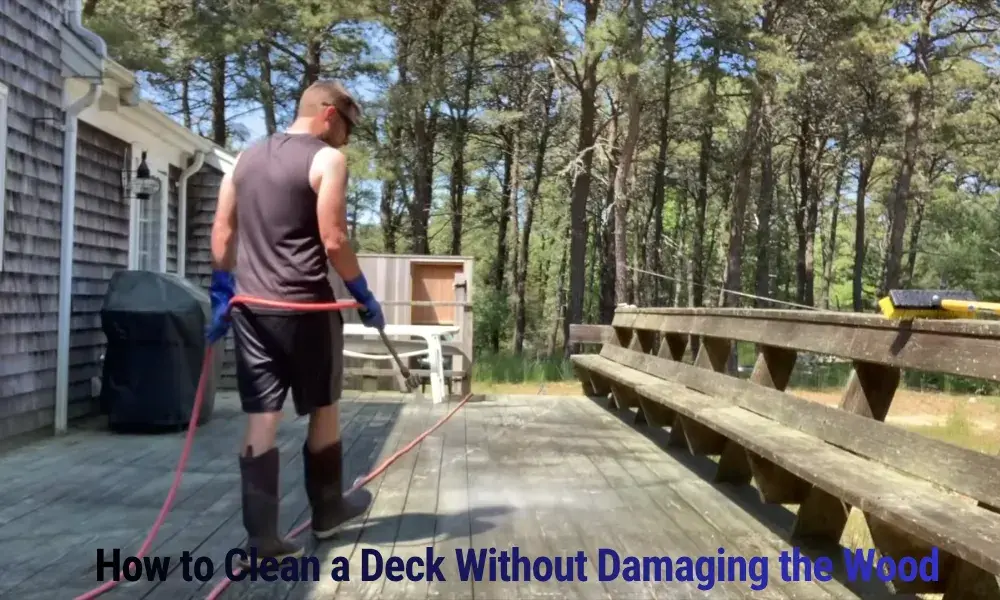
Clean with chemistry, rinse with pressure. Never the other way round. Apply a sodium percarbonate cleaner, let it dwell 10 to 15 minutes, agitate with a stiff synthetic brush, then rinse at 500 to 1,200 PSI using a 40 degree fan tip held 12 inches back. Finish with an oxalic acid brightener.
Pressure removes water. The cleaner removes the growth. Once you accept that, the whole question of how hard to spray mostly answers itself.
The damage looks fine while the boards are wet. That is the cruel part. Wet cedar hides everything. Two days later the deck dries out and the surface has gone fuzzy, with pale stripes running across the grain where the wand paused. Those stripes are called wand marks, and no cleaner on earth removes them. The only fix is sanding, board by board.
Our climate makes this worse than almost anywhere else in the country. Around eight months of damp, over 40 inches of annual rain, and a canopy of Douglas fir and big-leaf maple that keeps decks shaded and wet for weeks at a time. Damp softwood is soft softwood. The exact pressure that would barely mark a dry deck in Bend will chew through a wet fir board in River Road or Churchill.
Why pressure washing damages wood in the first place
Softwood is not uniform. Every board has soft spring growth and hard summer growth stacked in alternating layers, which is exactly what creates the grain pattern you can see. High pressure blasts out the soft layer and leaves the hard layer standing proud. That is why an over-washed deck ends up feeling like a cat’s tongue.
Western red cedar, the most common decking material on older Eugene homes, rates around 350 on the Janka hardness scale. Douglas fir sits near 660, and pressure-treated hem-fir lands in the same neighbourhood. Red oak flooring, for comparison, is close to 1,290. You are cleaning one of the softest structural woods in common use, while it is wet.
One afternoon, ten years of consequences
Once the fibres are raised, three things follow. The deck splinters underfoot. It holds dirt and moisture in the torn fibres, so it regrows algae faster than it did before. And it will not take stain evenly, because the fuzzy areas drink finish while the smooth areas repel it.
That is the real cost of an aggressive Saturday. Not a bad-looking deck for a week, but a maintenance problem that follows the boards for the rest of their life.
What is actually growing on your boards
Get this wrong and you buy the wrong product. Green, black and grey are three different problems that happen to share a deck. Here is the field guide we use on estimates.
Five things you are looking at, and what each one means
Walk the deck in daylight before you buy anything. What you see decides the treatment.
- Green film or fuzzy mats. Algae and moss. Extremely common on north-facing decks under fir. Moss holds water against the wood permanently, so it accelerates rot rather than just looking bad
- Fuzzy black patches that smear. Mildew. Responds well to a percarbonate cleaner and a brush
- Sharp black rings around nails and screws. Iron tannate, a chemical reaction between metal and the natural tannins in cedar. Cleaner will not touch it. Only oxalic acid will
- Uniform silver-grey. Not dirt at all. UV has broken down the lignin in roughly the top 1/32 inch. Cleaning removes it and reveals fresh wood, which is why a properly cleaned deck looks dramatically newer
- White chalky haze or patchy shine. Failing sealer, not growth. Cleaner strips this unevenly, so it needs a stripper instead. Different job, different risks
Dark tea-coloured streaks below railings and posts are a sixth possibility. That is tannin bleed, common on newer cedar and on decks that were sealed while still damp. It fades with brightener rather than cleaner.
What pressure is actually safe on a deck
Pressure alone is a bad measure. What hits the wood is the combination of pressure, nozzle angle and distance. A 1,200 PSI machine with a red zero degree tip held three inches away does far more damage than a 2,500 PSI machine with a white 40 degree tip held 14 inches away.
- 500–1,200 PSI working range on softwood decking
- 40° White fan tip, the only one for bare wood
- 12 in Minimum standoff from the board face
- $175–450 Professional deck cleaning in Eugene
Working ranges we use on Eugene decks
Softest material sets the limit. If you are not certain what you have, start at the bottom of the range and test somewhere hidden.
- Western red cedar. 500 to 900 PSI, 40 degree tip, 12 to 18 inches back
- Douglas fir. 600 to 1,000 PSI, 40 degree tip, 12 to 18 inches back
- Pressure-treated pine. 800 to 1,200 PSI, 40 degree tip, 12 inches back
- Tropical hardwood such as ipe or cumaru. 1,200 to 1,500 PSI, 25 degree tip, 10 to 12 inches back
- Railings, spindles and trim. 400 to 700 PSI at 18 inches, because thin sections mark far more easily than decking boards
Three technique rules matter as much as any of those numbers. Always move with the grain, never across it. Never stop the wand while the trigger is pulled, because a two second pause is exactly how wand marks are born. And run each stroke the full length of the board, feathering into the next one, so you never leave a hard start or stop line mid-run.
Test in a hidden spot first. Under the stairs, or the far corner behind the grill. Then let it dry fully before you judge the result, because wet wood lies to you about everything.
Which cleaner belongs on bare wood
Sodium percarbonate, sold as oxygen bleach or percarbonate deck cleaner. It breaks down into soda ash and hydrogen peroxide in water, lifts organic growth, and does not attack lignin the way chlorine does. It is also far kinder to the rhododendrons.
Products worth knowing, with honest assessments. Restore-A-Deck Cleaner is our default on bare wood. Powder concentrate, mixes clean, and it works. Not exciting, which is a compliment. Defy Wood Cleaner performs similarly and is easier to find in stock, though slightly slower on established moss.
Simple Green Oxy Solve Deck and Fence is convenient and stocked locally, but it is diluted for consumer safety, so you will use more of it than the label suggests on a genuinely dirty deck. Krud Kutter Deck and Fence Cleaner handles light seasonal grime and is underpowered against real Pacific Northwest moss.
The product we recommend but not for this job
Wet and Forget Outdoor is a slow-acting treatment you spray and leave. It takes weeks to months to clear growth, which is useless if you want the deck clean for a barbecue next weekend. As a maintenance spray in November on a deck you already cleaned properly in August, it is genuinely excellent. Right product, wrong moment.
Is chlorine bleach ever acceptable on a deck?
Here is where we break with a lot of the internet. The blanket rule of never use bleach on wood is oversimplified, and pretending otherwise makes homeowners distrust everything else you say.
Sodium hypochlorite is the backbone of professional soft washing in Eugene, OR. It kills organic growth on contact rather than lifting it mechanically, which is precisely why no pressure is needed on siding and roofs. Trex even recommends a wash containing detergent and sodium hypochlorite for mould on composite, while noting it lightens the surface.
On bare wood we avoid it. Hypochlorite degrades lignin, which is the same damage UV does, only faster. It leaves a bleached fuzzy character, corrodes fasteners over repeated applications, and is hard on landscaping if runoff is not managed. So the honest position is that bleach is a legitimate professional tool on the right substrate. Your bare cedar deck, on a Saturday, without dilution control, is not it.
The step almost everybody skips
If you take one thing from this article, take this one. Percarbonate cleaners are alkaline, and they leave bare wood with an elevated pH. Visually that reads as a dull, darkened, slightly orange or blotchy tone. Homeowners look at it and conclude the cleaner did not work. It worked. The wood is simply out of chemical balance.
Oxalic acid brightener neutralises the pH and restores the natural colour. It also does one thing nothing else does, which is dissolve iron tannate. Those black rings around every screw head disappear. Watching that happen is the most satisfying 90 seconds in this trade.
Two chemicals, not one
The process is clean, rinse, brighten, rinse again. Restore-A-Deck Brightener and Defy Wood Brightener both do the job. Straight oxalic acid crystals are cheaper if you are comfortable mixing your own, but wear gloves and eye protection, because oxalic acid is not casual stuff.
Skipping this is the single most common DIY mistake we see, and it is why so many people conclude their deck just looks old now and give up on it.
The safe process, start to finish
Realistic time for a 300 square foot deck is four to six hours including setup and cleanup. Not two hours. Plan the whole afternoon and you will not be tempted to rush the part that matters.
-
Clear the deck and repair before you wash
Move furniture, planters and the grill. Sweep debris out of the gaps between boards, because that trapped organic matter is half the moisture problem.
Then hammer down proud nails and replace failed screws. Cleaning a rotten board just gives you a clean rotten board, and a raised fastener will catch the brush and tear the wood around it.
-
Pre-wet the plants, then pre-wet the deck
Soak every plant within about eight feet before covering with plastic. Pre-wetting matters more than the covering does, because a hydrated plant absorbs far less of anything that reaches its roots.
Then rinse the whole deck with plain water. Dry wood absorbs cleaner unevenly, and uneven absorption is what produces streaks you cannot wash out later.
-
Apply cleaner and let it dwell
Ten to fifteen minutes. Do not let it dry on the boards. If the sun is on the deck, mist it again partway through to keep the surface wet.
This is the part people cut short, and every minute you take off the dwell time you end up paying for in pressure later.
-
Agitate with a brush, working with the grain
This is where the cleaning actually happens. A stiff synthetic brush on a pole, moving along the boards rather than across them.
Skip this step and you are compensating with the wand, which is the exact failure mode this whole article exists to prevent.
-
Rinse low, brighten, rinse again
Fan tip, 12 inches back, full length strokes, wand always moving. Then apply brightener and let it dwell 10 to 20 minutes per the label.
The final rinse needs to be thorough. Residue left behind causes blotching that only becomes visible once the deck is dry, which is far too late to fix easily.
-
Let it dry properly before any finish goes on
48 to 72 hours, and in Eugene humidity assume the long end. The wood needs to reach roughly 15 percent moisture content before a sealer will bond.
A cheap pin-type moisture meter removes all the guesswork here. Sealing damp wood is how you get a finish that peels off in sheets the following spring.
What changes if your deck is composite
Composite is not maintenance free, it is maintenance different. Mould on composite grows in the surface film of pollen and organic debris, not in the material itself, so the job is about removing that film rather than scouring the board.
Trex publishes clear limits for its Transcend, Enhance and Select lines. A pressure washer no greater than 3,100 PSI, with a fan attachment and soap dispenser, spraying and rinsing each board with the tip no closer than eight inches, plus a soft bristle brush and a thorough rinse so dirty water does not dry into a film.
Treat 3,100 PSI as a ceiling, not a target
We work capped composite at 1,500 to 2,300 PSI and have never needed more. Early generation uncapped boards, common on Eugene decks built in the 2000s, are not covered by that guidance at all and should be cleaned with soap, water and a brush.
Not sure which you have? Look at a cut end. Capped boards show a thin shell over a differently coloured core, like a candy coating. Uncapped boards are the same colour all the way through.
When the deck needs a carpenter, not a wash
Before any water touches the boards, do this. Take a screwdriver and press the tip firmly into the wood at the base of every post, along the ledger where the deck meets the house, and on any board noticeably darker than its neighbours. Sound wood resists. Rotten wood accepts the tip like firm cheese.
- Soft spots at the ledger board, where the deck attaches to the house. Deck failures overwhelmingly happen at this connection rather than in the middle of the field
- Springy or bouncing boards underfoot, which points to a joist problem below rather than a surface problem above
- Rust weeping from below a board rather than staining around a single fastener, which usually means the hardware underneath is failing
- Visible fungal growth on the joists, which you only find by getting underneath with a flashlight
- Posts that move when you push firmly at railing height
We tell homeowners this on estimates and walk away from the work when we see it. Cleaning a structurally compromised deck is a liability, not a service, and washing it makes the problem harder to spot rather than easier.
The right window for this in Eugene
Late June through mid September. That is the window here, and it is narrower than most of the country gets. You need two to three consecutive dry days with temperatures between 55 and 85 degrees. Below 50 the chemistry slows to a crawl. Above 85 in direct sun your cleaner dries before it can dwell.
If you plan to seal afterwards, the window tightens again, because the boards need to dry down to roughly 15 percent moisture content first. In this valley that realistically means July and August.
One local detail that catches people out. Eugene City Code 6.446 requires wash water from exterior cleaning to be collected and discharged to a vegetated area or the sanitary sewer rather than a storm drain. Storm drains here run to Amazon Creek and on to the Willamette with no treatment in between. On a deck surrounded by lawn this is easy, since gravity already does what the code wants. On a deck draining onto a driveway that slopes to the street, berm the edge with a rolled towel and direct the water into landscaping.
Sources for this section: the City of Eugene’s stormwater and water quality guidance, and the published Trex care and cleaning instructions for the composite figures above.
What this costs, done yourself or done for you
Three levels sit on this decision, and most Eugene decks land squarely in the first one.
-
Surface
Clean and brighten
Removes algae, moss, mildew, tannin and grey UV damage. The wood underneath is sound and comes back looking close to new.
Fits the large majority of decks.
-
Refinish
Clean, sand and reseal
Needed where a previous wash raised the grain, or where an old film-forming finish has started to fail across the boards.
Adds days, not hours.
-
Structural
Replace boards or framing
The only answer for rot at the ledger, failing joists or soft posts. A carpentry job that has to come before any cleaning.
Cleaning cannot help here.
Our deck cleaning service runs $175 to $450 for most residential decks, covering cleaning and brightening. The spread comes from square footage, height and access, how much railing and spindle work is involved, and how established the growth is. Sealing is separate work with separate material cost.
Doing it yourself costs roughly $60 to $90 in cleaner and brightener, plus $60 to $100 to rent a machine for the day, plus your afternoon. The maths is closer than people expect, and it stops being close at all if you have to sand out wand marks afterwards.
Where hiring out genuinely makes sense is elevated decks where you would be working off a ladder, decks with heavy established moss, decks over water features or sensitive planting, and any deck you are selling a house from. Where DIY makes perfect sense is a ground level deck with light seasonal grime and someone willing to do the brushing step properly. We would rather say that than sell you something you do not need.
Book it as one visit and save the trip
Most homeowners here have the same growth on more than one surface. If the deck has moss, the fence usually does too, and the same is true of the walkway beside it. Bundling fence cleaning in Eugene or patio cleaning into the same appointment costs less than booking each one separately.
One ordering note that saves people a repeat job. Always work top down. Runoff and loosened growth from house washing lands on whatever is below it, so the deck should be the last surface you touch, not the first.
FAQs About Cleaning a Deck Without Damaging It
Can I clean my deck with just soap and water?
For light dust, pollen and seasonal grime, yes. Warm water, a mild detergent and a stiff brush handle it. Established algae, moss or mildew needs a sodium percarbonate cleaner, because detergent lifts loose dirt but does not kill organic growth living on the wood.
What PSI is safe for a wood deck?
Between 500 and 1,200 PSI covers cedar, Douglas fir and pressure-treated pine, with cedar at the low end. Nozzle and distance matter as much as the number. Use a 40 degree fan tip, hold it at least 12 inches from the boards, and keep the wand moving at all times.
Will bleach damage my deck?
On bare wood, repeated use degrades lignin, leaves a fuzzy bleached surface and is hard on fasteners and nearby plants. Chlorine has legitimate professional uses on siding, roofs and some composite at controlled dilution. On an untreated cedar or fir deck, a percarbonate cleaner is the better choice.
Why did my deck turn fuzzy after cleaning?
Too much pressure, too close, or a nozzle that was too narrow. The soft spring growth in the wood has been blasted out and the fibres are standing up. Light cases sand out with 60 to 80 grit on a pole sander. Severe cases need a floor sander or replacement boards.
What removes the black spots around deck screws?
Oxalic acid brightener. Those rings are iron tannate, a reaction between metal fasteners and the natural tannins in cedar and redwood. Standard cleaners do not touch them, and no amount of extra pressure will either. This is the specific problem the brightening step solves.
How often should a deck be cleaned in Eugene?
Once a year, ideally in summer. Around eight months of damp and heavy fir and maple canopy regrow algae quickly here. Annual cleaning on a sound deck costs a fraction of the sanding and restoration a neglected deck eventually needs.
Does deck cleaner kill plants?
Percarbonate cleaners are relatively gentle, but concentration still matters. Pre-wet every plant within about eight feet before you start and rinse them again afterwards. A hydrated plant absorbs far less of anything that reaches it. Chlorine-based products are much harder on root zones.
How long should a deck dry before sealing?
Give it 48 to 72 hours of dry weather, and in this climate assume the long end. The wood needs to reach roughly 15 percent moisture content before a finish will bond properly. A pin-type moisture meter removes the guesswork. Sealing damp wood is the main cause of a finish that peels within a year.
Can I pressure wash a newly built deck?
Wait. New pressure-treated lumber needs a drying period, typically a few months here depending on when it was installed. New cedar can be cleaned lightly to remove mill glaze before staining, but there is rarely any growth to remove yet, so heavy washing only risks raising the grain.
Can I pressure wash a composite deck?
It depends on the product. Trex allows a pressure washer no greater than 3,100 PSI on its Transcend, Enhance and Select lines, using a fan tip held no closer than eight inches, with soap and a soft bristle brush. Early generation boards are cleaned by hand instead. Treat the published figure as a ceiling, not a target.
Does cleaning remove old stain?
Partially and unevenly, which is the problem. A cleaner strips failing finish in patches while sound finish stays put, leaving a blotchy surface. If your existing stain is still largely intact, the job needs a stripper rather than a cleaner, and that is a different process with different risks.
Should I clean the deck or the siding first?
Siding first, every time. Runoff, loosened growth and debris from washing a house lands on the deck below, so cleaning the deck first means doing it twice. The same logic applies to roofs and gutters. Work top down and the deck becomes the last surface you touch.
Your pressure washer is a rinsing tool, not a cleaning tool
Go back to that homeowner with the rented machine. Nothing about the intent was wrong. They wanted a clean deck before a party and reached for the tool that looked fastest. The tool was the problem, not the ambition.
The cleaning is done by chemistry and a brush. The wand only carries the water that takes the loosened growth away. Once that lands, you stop needing pressure to compensate for skipping the dwell time, and the deck stops paying for the shortcut.
If your deck is twenty years old and structurally sound, would you rather restore it every few years or put that money toward replacing it? We argue about that one internally.
Get the Deck Clean Without Sanding It Afterwards
Tell us the deck size, the wood or composite type, and what is growing on it. We will tell you what it needs, and say plainly if the answer is repairs rather than a wash.
Evergreen Surface Care provides pressure washing Eugene, OR and nearby Lane County. Free written estimate. Surface-safe methods. No surprise charges.