
Gutter Care · Eugene, OR
How Often Do Gutters Need Cleaning in Eugene’s Rainy Season?
A Eugene gutter can look fine in September and overflow by November. The national “twice a year” rule does not survive contact with a Douglas fir. Tree cover, not house size, is what sets your schedule — and the debris you pull out this year tells you what next year needs.
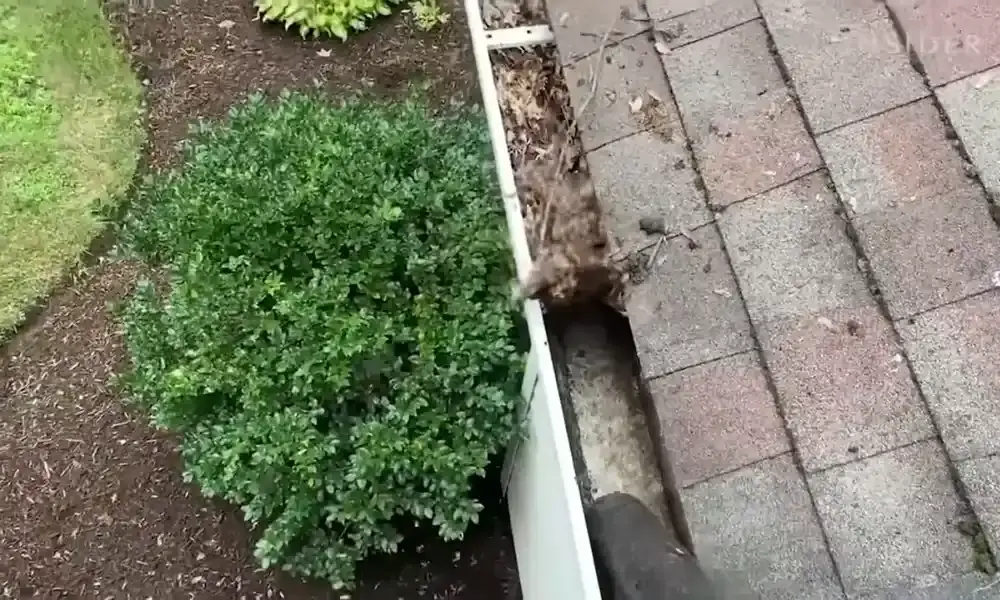
Most Eugene homes need gutters cleaned one to two times per year. Homes under mature Douglas firs or several large deciduous trees typically need two to four cleanings or inspections. A sunny home with an open roofline may only need one.
Start with late fall and spring, then adjust based on what actually comes out. The debris removed last time is a better guide than any national average.
That September-to-November change happens fast for a simple reason: leaves start falling just as regular rain returns, fir needles keep dropping year-round, and roof grit washes toward the outlets. A few wet days turn loose debris into a packed layer sitting exactly where water needs to leave.
Eugene raises the stakes more than most cities. National Weather Service normals put annual precipitation at 40.83 inches, and 37.50 of those inches fall between October and May. That is roughly 92 percent of the year’s rain arriving across eight months, during the same window that produces the most debris.
- 40.83 in Eugene annual precipitation normal
- 92% Of that rain falls October to May
- 7.21 in December average, vs 0.32 in July
- $125–450 Typical Eugene gutter cleaning
How often should you clean gutters in Eugene?
One or two cleanings a year for most homes, with three or four checks on heavily wooded properties. Use the table as a starting point, then let the property correct you.
| Property condition | Suggested frequency | Best starting schedule |
|---|---|---|
| Few nearby trees, open roofline | 1× yearly | Late fall |
| Moderate tree cover | 2× yearly | Late fall and spring |
| Heavy deciduous trees | 2–3× yearly | During leaf drop, late fall, spring |
| Douglas firs or other conifers nearby | 2–4× yearly | Seasonal checks through the year |
| Complex roofline, additions, dormers | 2–3× yearly | Fall and spring, plus post-storm checks |
| Known clogging history | 3+ checks yearly | Before and during wet season |
| Gutter guards installed | 1+ inspection yearly | Late fall or spring |
| Rental or commercial property | Site dependent | Planned preventive schedule |
Treat these as ranges, not rules. Your gutters do not know what month it is; they respond to whatever lands in them. One property may stay clear for a full year while another collects enough fir needles to restrict an outlet in six weeks.
The most reliable guide is what came out last time. After a gutter cleaning in Eugene, the volume and type of debris removed tells you more about your real frequency than any national average ever will.
Why the rainy season sets the schedule here
Rain does not clog a gutter. Debris does. Rain just exposes the problem — and in Eugene it does so for eight months without a meaningful break.
The monthly normals show how quickly the load arrives: 3.17 inches in October, 5.98 in November, 7.21 in December, and another 6.05 in January. Once autumn settles in, the drainage system gets almost no rest.
A few handfuls of dry September leaves seem harmless. Add weeks of rain, roof grit, needles and organic material, and that debris compacts around an outlet. Water then takes another route — over the front edge, behind the gutter, down the siding, or into the ground beside the foundation.
Overflow is not an early warning
By the time water is pouring over the front edge during a storm, the maintenance window has already closed. Waiting for a dramatic overflow is not a schedule — it is confirmation that you needed one.
If you are already seeing overflow, plants, staining or sagging, compare what you have against these signs of clogged gutters before deciding how urgent it is.
The best months to clean gutters in Eugene
Late fall and spring are the two windows that matter most. Tree-heavy properties add a third visit during peak leaf drop. These four windows run in sequence, and each one has a different job.
-
Late September to October — inspect
A check, not always a full cleaning. Look at outlets, downspouts and roof valleys before sustained rain arrives. If summer needle drop, seed pods or moss fragments have already collected, clear them now.
This is the cheapest visit of the year. Clean gutters ahead of the fall rain also reduce water backing up at the lower edge of the roof.
-
November to December — the primary cleaning
For homes with deciduous trees this is the important one. Wait until most leaves have fallen, but not so long that packed debris blocks drainage during heavy rain.
Timing is set by your trees, not the calendar. If one large maple dominates the backyard, its drop matters more than the date.
-
March to May — the reset
Winter wind moves needles, twigs, moss fragments and roofing grit into the gutters, and material that survived winter settles around the downspout openings.
Spring also gives you a clear look at sagging sections, loose hangers and slope problems while the weather is still workable.
-
June to August — monitor only
Rainfall drops sharply, but debris does not stop under conifers. Most properties need nothing here beyond an occasional look.
Summer is the right time to trim overhanging vegetation and handle roof maintenance that would be unsafe in the wet season.
Do homes under Douglas firs need more frequent cleaning?
Usually yes. Conifer debris makes a two-cleaning schedule too relaxed for many Eugene properties, because the debris never arrives as a single event you can plan around.
-
Predictable
Deciduous trees
Leaves turn, fall over a few weeks, and stop. You can schedule one cleaning after the drop finishes and be genuinely done.
One well-timed visit often covers it.
-
Year-round
Douglas firs and conifers
Needles, twigs and cones reach the roof across multiple parts of the year, and wind makes the pattern unpredictable. There is no “after” to wait for.
Inspection beats scheduling.
This is why tree cover matters more than square footage. A large house in an open subdivision often has fewer gutter problems than a small bungalow under mature firs. OSU Extension makes the same point about roofs generally: overhanging vegetation both shades the surface and drops material that accumulates and holds moisture.
Start with four touchpoints, then cut back
You may find that all four are unnecessary. That is a good outcome — the goal is keeping water moving, not maximising cleanings.
- Inspect before regular fall rain begins, usually late September
- Check during the main autumn debris drop, when needles and leaves overlap
- Clean after the heaviest drop finishes, typically November or December
- Inspect again in spring to clear what winter wind moved in
Does moss change how often gutters need cleaning?
Yes. Moss adds a second, slower-moving source of debris to a system that already handles plenty. It is also the one source that keeps producing material long after the trees have finished.
OSU Extension notes that roof moss traps soil and debris, which holds water and keeps the roof wet longer. OSU’s Solve Pest Problems guidance adds that moss growth can slow or block water flow off the roof entirely, and that dried moss and roof debris are flammable — a real consideration during Oregon’s ember season.
If the gutter keeps refilling, look uphill
Roof valleys collect needles, shaded slopes hold organic buildup, and rain carries loose material toward the eaves. Cleaning only the gutter treats the destination rather than the source, which is why some properties seem to clog again within weeks.
Where moss is established across the roof, handle it separately through roof cleaning and moss removal in Eugene. One warning: do not assume high pressure is the answer. Roof materials are easily damaged by aggressive methods.
Why some Eugene gutters clog faster than others
Two houses on the same street with the same trees can need very different schedules, because the drainage systems themselves are doing different amounts of work. Four design factors matter more than most homeowners realise.
- Downspout capacity. OSU Extension’s rainwater guidance recommends about one square inch of downspout area per 100 square feet of roof. A 3×4-inch downspout gives 12 square inches — enough for roughly 1,200 square feet. Long runs draining to too few downspouts back up sooner
- Gutter slope. Roughly 1/16 inch of fall per foot keeps water and fine debris moving. Flat or reverse-sloped sections hold standing water, and standing water is where debris turns into sludge
- Gutter profile. Rounded-bottom gutters limit debris buildup over time compared with square-bottom profiles
- Roofline complexity. Valleys, dormers, additions and intersecting slopes funnel debris toward a handful of sections. One clean front gutter tells you nothing about what is happening behind an addition
Worth noting: standard-sized gutters generally handle western Oregon fine, because our storms are less intense than the annual rainfall totals suggest. The problem here is rarely volume. It is duration plus debris.
How to tell your current schedule is too infrequent
Gutters give several warnings before a complete blockage. The trick is that most of them are only visible while it is raining.
Ten signs your interval is too long
Do not judge gutter performance on a dry afternoon. A system can look spotless from the ground while one outlet is fully restricted.
- Water spilling over the front edge
- Water dripping behind the gutter
- Little or no water leaving a downspout during rain
- Plants growing inside the trough
- Visible leaves or needles above the gutter edge
- Dark streaks on the gutter faces
- Water marks on siding below the roofline
- Sagging gutter sections or pulled hangers
- Persistent wet ground near a downspout
- Moss and debris collecting in roof valleys
Downspouts deserve particular attention. Clearing visible leaves from the trough does nothing when a packed clog sits inside an elbow, which is why our gutter cleaning service covers accessible outlets and downspouts rather than just skimming the top.
Do gutter guards reduce cleaning frequency?
Guards reduce large debris. They do not make gutters maintenance-free. This is probably the most persistent myth in gutter maintenance, and it costs people money when they stop inspecting entirely.
A guard may stop a maple leaf. It will not reliably stop fir needles, roof grit, seeds, dirt or fine organic material — and debris collects on top of the guard itself, where it can block water from ever reaching the opening. OSU Extension’s rainwater guidance is direct on this: leaf screens are prone to clogging, especially when they are not checked and cleaned regularly.
Some guard designs are far easier to service than others, and some must be lifted or removed entirely before the trough can be cleaned. That matters for both cost and access.
The free test that tells you everything
Stand outside during a solid Eugene rain and watch the guards. Water sheeting over the top instead of entering the gutter means the system is not working, regardless of how clean the guard looks from the ground.
If your guards are performing well you may need fewer full cleanings — but you still need at least one inspection a year.
What gutter cleaning costs in Eugene
Most Eugene homes fall inside this range for a full cleaning. Single-story homes with short, accessible runs sit near the bottom; two-story homes with long runs, guards to remove, or several years of buildup sit near the top.
Every quote we give is written and free — request one here or call (541) 603-0340.
Price is driven by a handful of practical factors, and it is worth knowing which ones you can actually control:
- Linear footage of gutter, not house square footage
- Number of stories and how difficult ladder access is
- Roof pitch and whether the roof can be safely walked
- Guards that need to be removed and reinstalled
- Debris load — a first cleaning after several neglected years takes far longer than annual maintenance
- Downspout clogs requiring flushing or disassembly
A schedule usually costs less than a rescue
A property on a preventive schedule almost always costs less per year than one cleaned only after a problem appears. Catch-up cleanings take more time, and they sometimes uncover fascia or siding damage that routine maintenance would have prevented entirely.
If the roof needs attention too, book both together. Runoff works top down, so gutters should be cleared after any roof cleaning rather than before it.
Is DIY gutter cleaning worth it during the rainy season?
It can work on simple, safely accessible homes. Wet Eugene conditions make ladder and roof work considerably less forgiving, and access is the real issue rather than the debris.
Expect wet leaves, mud, needles, roof grit, moss fragments and material packed hard around the outlets. Unpleasant, but manageable. Wet roofs, moss-covered surfaces, soft ground, steep slopes and awkward ladder positions are the parts that actually hurt people.
Three thresholds worth respecting
OSU Extension’s roof guidance recommends safety belts and lines when the roof pitch exceeds 23 degrees, when working within six feet of the edge, or when eaves are more than 16 feet off the ground.
If your job crosses any of those lines, it is not a ladder-and-gloves afternoon. A reachable gutter above a single-story garage is a genuinely different job from a second-story run over a sloped yard.
If you are handling a straightforward gutter yourself, the order matters as much as the effort:
- Work in dry, calm weather — not between storms
- Set the ladder on firm, level ground
- Never reach sideways from the ladder; move it instead
- Clear debris in manageable sections rather than dragging it along
- Pay close attention to the outlets, not just the trough
- Flush each downspout and confirm flow at the bottom
- Stop if the roof or the access feels unsafe
When to ignore the calendar entirely
Some events reset your schedule regardless of when the last cleaning happened. The roof and gutter are one drainage path: rain lands on the roof, moves through the valleys toward the eaves, and the gutter carries it to the downspouts. Anything loosened up top follows the same route down.
On a South Eugene project beneath mature firs, the shaded slope carried heavy moss, and clearing the gutters was part of the cleanup after the roof was treated. After significant roof cleaning in Eugene, gutters often need attention even if their normal service date is months out.
The same applies after any of these:
- Heavy wind, especially the first real storm of the season
- Tree trimming anywhere near the roofline
- Roof repairs or partial reroofing
- Moss treatment, which keeps shedding material for weeks
- An unusually concentrated leaf drop
- A long dry spell followed by the first strong rain
Can clogged gutters damage the rest of the exterior?
A clog changes where roof runoff travels, sending water across surfaces never designed to handle it — fascia, siding, entryways, landscaping and pavement.
The first visible symptom often appears well away from the actual clog. Dark staining below a gutter, for example, does not necessarily mean the gutter exterior is dirty. It frequently means repeated overflow, and cleaning the siding without fixing the drainage leaves you treating a symptom.
If the exterior has already developed organic staining, house washing in Eugene can address it once the drainage problem is understood. Water management first, cosmetic cleaning second. For property managers, gutters usually sit inside a broader plan — see commercial exterior cleaning in Eugene.
Sources for this article: NOAA and NWS Eugene precipitation normals (1991–2020) for all rainfall figures; OSU Extension Harvesting Rainwater for Use in the Garden (EM 9101) for gutter sizing, slope, profile and leaf screen maintenance; OSU Extension Maintaining a moss-free roof for roof moss and roof-work safety thresholds; and OSU Solve Pest Problems: Moss on Roofs & Walkways for moss, water flow and fire risk.
FAQs About Gutter Cleaning Frequency in Eugene
What is the right gutter cleaning frequency for a Eugene home?
One to two cleanings per year suits most properties. Homes surrounded by mature firs, maples or other heavy tree cover typically need two to four cleanings or inspections. Tree cover, not house size, is what sets the schedule.
What is the best time of year to clean gutters in Eugene?
Late fall and spring. Late fall removes seasonal leaves before the wettest months. Spring clears what wind, rain, needles and roof debris deposited over winter.
Should I clean my gutters before the rainy season?
Check them, yes. An early autumn inspection confirms outlets and downspouts are clear before Eugene’s wet months begin. A full cleaning is only needed if debris has already accumulated.
How often should gutters under Douglas fir trees be cleaned?
Start with two to four inspections a year. Fir needles fall outside the normal autumn window, so a simple spring-and-fall schedule often is not enough.
Do gutters need cleaning during winter?
Not automatically. But visible overflow or blocked drainage should not be ignored just because winter has already arrived.
Do gutter guards eliminate cleaning?
No. Guards reduce some debris but still collect needles, grit, seeds and organic material, and they can clog on top. Plan on inspecting guarded gutters at least annually.
Does moss clog gutters?
Moss fragments become part of the debris load, and roof moss traps leaves and needles that later wash toward the gutters. Roof moss is often the upstream cause of a recurring gutter problem.
Should gutters be cleaned after roof cleaning?
Usually. Roof cleaning loosens moss and debris that travels to the eaves. Check the gutters afterward so released material does not block the outlets.
How much does gutter cleaning cost in Eugene?
Most Eugene gutter cleanings fall between $125 and $450. Price is driven by linear footage, number of stories, access difficulty, whether guards must be removed, and how much debris has built up since the last cleaning.
How often should rental property gutters be cleaned?
Fall and spring is a sensible starting schedule, with additional service on wooded lots. Photo documentation helps owners track changing conditions between visits.
The right frequency is the one your property actually needs
“Clean your gutters twice a year” is a reasonable starting point and a poor rule. A home with open sky above the roof may need one annual cleaning. A shaded property under mature Douglas firs may need three or four.
Eugene raises the stakes because roughly 92 percent of the annual rainfall arrives between October and May. You want the drainage path clear before debris and rain become a problem at the same time — which, here, means before the middle of November.
Start with late fall and spring. Then let the property correct you. You do not need more gutter cleaning than your property requires — you just need it before the clog makes the decision for you.
Get It Cleared Before the Rain Makes the Decision
Tell us the roof height, roughly how much gutter you have, and what is growing above it. We will clear the troughs, flush the downspouts, and tell you what interval your property actually needs.
Evergreen Surface Care provides pressure washing Eugene, OR and nearby Lane County. Free written estimate. Surface-matched methods. No surprise charges.