
Gutter Care · Eugene, OR
Gutter Guards Eugene: Do They Work Under Fir and Maple Trees?
A maple leaf is easy to block. A Douglas fir needle is not. Most guard marketing is built around the first problem and quiet about the second. Guards reduce debris — they do not end gutter maintenance — and the design you choose matters far more than the brand on the box.
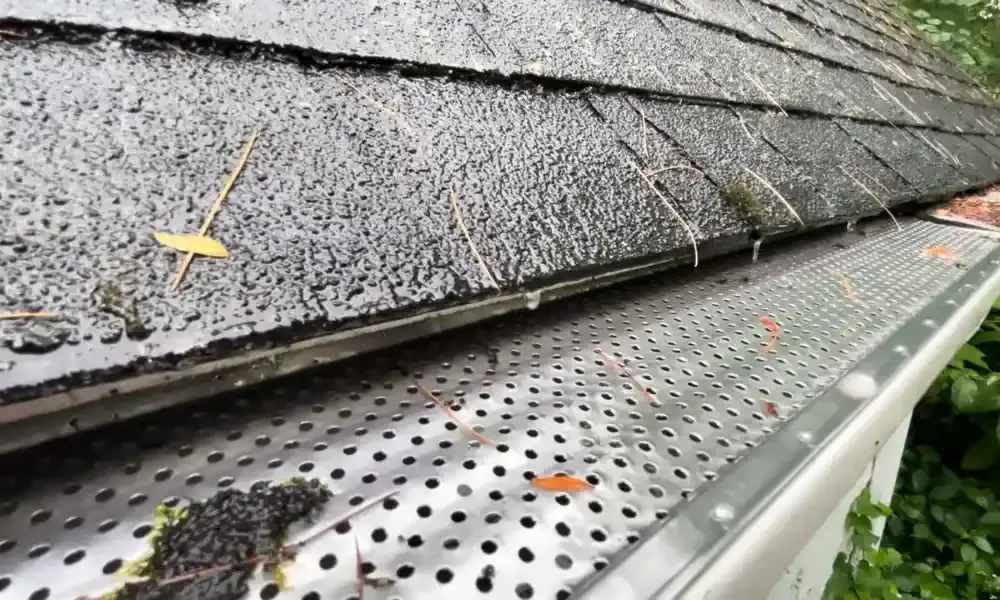
Yes — but only as debris reduction, never as a replacement for gutter maintenance. Under Douglas fir cover, fine stainless steel micro-mesh is the design that holds up. Wide screens, brushes and foam inserts usually create more work than they save.
The question that actually decides whether a guard is worth it is not how much debris it blocks. It is how easily someone can open it when debris eventually gets underneath.
That last part is where homeowners comparing Gutter Guards Eugene systems often get caught out. A guard that stops 90 percent of debris but takes two hours to remove can be a worse outcome than an open gutter you can clear in twenty minutes.
- 40.83 in Eugene annual precipitation normal
- 92% Of that rain falls October to May
- 6–12 in Typical bigleaf maple leaf width
- $125–450 Typical Eugene gutter cleaning
Gutter Guards Eugene: Why Fir and Maple Trees Make Them Harder to Use
For homeowners researching Gutter Guards Eugene options, the real challenge is handling heavy rain, fir needles, maple leaves, seeds, moss, and fine organic debris throughout the year. Eugene combines two things most guard marketing quietly ignores: mixed fine-and-coarse tree debris, and months of steady rain that turns that debris into a mat.
National Weather Service normals put Eugene at 40.83 inches of precipitation a year, with 37.50 of those inches falling between October and May. The timing matters as much as the total. Summer is comparatively dry, so debris accumulates quietly along the roof edge for months with nothing to flush or reveal it. Then the rain returns, and everything up there gets wet at once.
Meanwhile the Willamette Valley gives most properties both Douglas fir and bigleaf maple, often on the same lot. That single combination produces at least eight kinds of debris:
- Fine fir needles — the debris that defeats most guard designs
- Large maple leaves — easy to block, hard to keep off the surface
- Maple samaras — the winged seeds, small enough to enter seams
- Twigs and small cones
- Pollen, heaviest in spring
- Roof granules shed by aging composition shingles
- Moss fragments washing down from shaded slopes
- Organic grit and dust that turns to sludge in standing water
Bigleaf maple deserves specific attention. Oregon State describes leaves commonly running 6 to 12 inches across, with fruit in the form of a double samara. Seeds mature around September and October and can disperse from October through January. So one tree sends both the largest debris on your roof and some of the smallest, across a four-month window.
The mismatch at the centre of the problem
Most guards are designed against one debris size. Eugene roofs deliver several at once. A basic screen stops the leaf and lets the seed through — which is why homeowners often describe their guards as working and clogging at the same time.
Why fir needles are the real test
A maple leaf is an easy target. It arrives as one large object and sits on top of almost anything. A needle behaves nothing like that: narrow enough to pass through many openings, straight enough to lodge vertically in a slot, and shaped so that one caught needle catches the next. From there it collects finer material, and steady rain turns the whole thing into a mat.
-
Manageable
Bigleaf maple leaves
Arrive as large, single objects during a defined drop window. Almost any decent guard blocks them, and dry leaves often blow clear on their own.
The guard usually wins.
-
The real test
Douglas fir needles
Fall across multiple parts of the year, pass through wider openings, and interlock into a dense wet layer that fine material then packs out.
Opening size decides everything.
Independent testing has found the same pattern with pine-type needles. This Old House reported that small needles and seeds passed through conventional screens and brush-style guards, while micro-mesh blocked them far more effectively. Consumer Reports found fine-mesh screens outperformed screens with larger openings, and that performance varied widely between designs.
Local installers acknowledge the limit too. At least one Eugene and Springfield area company states plainly that its removable guards handle larger leaves well but can still admit fir needles, dirt and grit. That is a more honest promise than “never clean your gutters again” — and it is the right way to think about the whole category. No guard changes what falls out of the tree. It only changes where the debris stops.
Which guard type works best under fir trees?
Fine stainless steel micro-mesh is the strongest starting point for heavy needle exposure. Both older independent testing and recent product testing point the same direction: opening size is the variable that matters most.
| Guard type | Fir needles | Maple leaves | Main concern in Eugene |
|---|---|---|---|
| Stainless micro-mesh | Very good | Very good | Surface buildup still needs clearing |
| Fine metal screen | Good | Very good | Entirely dependent on opening size |
| Perforated metal | Fair | Very good | Needles enter larger perforations |
| Reverse-curve | Fair to good | Good | Wet debris can disrupt water entry |
| Brush | Poor to fair | Fair | Needles lodge in the bristles |
| Foam insert | Poor to fair | Good initially | Fine debris embeds in the material |
| Large plastic screen | Poor | Good | Needle-sized debris passes straight through |
This table compares designs, not installations. A premium micro-mesh fitted with gaps at the end caps will underperform an ordinary screen fitted properly. Installation quality can invert every row here.
Can micro-mesh keep up with Eugene rain?
Usually — but water capacity deserves as much attention as filtration, and the two goals compete. A guard has to block debris and accept water fast enough. Smaller openings improve the first and put pressure on the second, especially once debris is lying across the surface. Consumer Reports found some systems that shed debris well were only middling under severe simulated downpours.
Roof geometry adds a second variable no showroom demo accounts for. Water arrives fastest where:
- Two roof slopes meet and funnel into one gutter section
- A valley directs a large catchment area to a single outlet
- The pitch is steep enough to accelerate runoff
- Several roof planes drain toward one corner
- Downspout capacity was already marginal before the guard went on
The free test that tells you more than any brochure
Pouring a jug over a six-inch showroom sample tells you nothing. Standing outside during a solid Eugene rain and watching your own gutters tells you everything.
If water consistently overshoots one corner, you have a capacity or roof-flow problem, not a filtration problem — and a finer guard will make it worse, not better.
Three designs to be careful with under firs
-
Brush guards
Long bristles sit inside the gutter and water passes between them. The concept is simple and the failure mode is obvious once needles arrive: a brush gives narrow debris hundreds of places to lodge.
Testing has found needles and small seeds passing through or catching in brush systems, and a Portland-area contractor makes the same regional case against them: trapped fine debris decomposes into sludge inside the trough. Fine on a low-debris property. Rarely the first choice under mature firs.
-
Foam inserts
Foam fills the gutter and lets water through its pores. The long-term question is what happens to the grit, needles and organic particles that work into the material.
Once the insert is dirty, you have debris inside the gutter that has to be pulled out before the trough can be cleaned at all. A Portland-area gutter contractor advises against foam entirely in this region, on the grounds that Oregon’s moisture levels turn it into a host for mould and moss.
-
Large-hole screens
Inexpensive and genuinely effective against large leaves. Far less convincing against needles. This Old House tested A-M Gutter Guard’s perforated aluminium design, for example, and found it handled larger debris well while smaller dirt and pine needles passed through the openings.
That does not make it a bad product. It makes it a poor match for this debris — and that distinction should drive every guard decision you make.
What about LeafFilter, Raptor, LeafGuard and the rest?
The design matters more than the logo. Once you know the category, you can predict most of the performance.
- LeafFilter — micro-mesh. Tested well against both large and small debris, including needle-sized material
- Raptor — stainless micro-mesh in an aluminium frame. Good filtration and water handling in testing, though fine dirt can still pass
- Waterlock Pro — tested in both reverse-curve and micro-mesh configurations; compatibility varies by roof and gutter type
- A-M Gutter Guard — perforated aluminium. Blocks larger debris better than needles
- LeafGuard — integrated reverse-curve rather than a mesh overlay, which means replacing the gutter, not just covering it
Consumer Reports has evaluated Gutterglove and Amerimax products in past rounds, and its broader conclusion is the useful one: opening size and design drive needle performance far more than brand does.
One practical warning. Do not make this decision at a home show, watching someone tip dry leaves over a small display. Your roof does not receive dry showroom leaves. It receives wet needles, maple seeds, shingle grit, pollen and moss fragments, in November.
What do gutter guards cost in Eugene?
Pricing varies more in this category than almost any other home improvement, because it spans DIY strips from a hardware store to full-service installs with long warranties attached.
| Tier | Per linear foot | 150–200 ft home | Realistic expectation under firs |
|---|---|---|---|
| DIY foam and plastic screen | $1.50–$3.50 | $225–$700 | Shortest useful life; foam holds moisture badly here |
| DIY metal screen and basic mesh | $2–$5 | $300–$1,000 | Workable if you fit it properly and seal the end caps |
| Installed screen / perforated aluminium | $4.70–$9 | $705–$1,800 | Strong on leaves, marginal on fir needles |
| Installed micro-mesh, independent contractor | $6–$13 | $900–$2,600 | The sensible target for most Eugene fir properties |
| Branded full-service system | $22–$40 | $3,300–$8,000 | Premium pricing; read the warranty terms closely |
Local figures sit near the bottom of that spread. Cost data for Eugene specifically puts installed gutter guards at roughly $3.50 to $9.60 per linear foot depending on type, with steel screen around $4.70 to $6.40 and solid surface or reverse-curve systems around $6.70 to $9.60. A Portland-area installer reports labour alone running $3 to $7 per linear foot across the Oregon metro — higher than the $2 to $6 national average, because of regional wage rates and the safety equipment two-story work requires.
Why quotes for the same job differ by thousands
Angi’s 2026 data puts professional gutter guard installation at $6 to $13 per linear foot, averaging about $1,521 per project. This Old House’s 2026 survey of 1,000 homeowners reports roughly $40 per linear foot — around $7,900 for a 200-foot system — because that figure covers buyers of industry-leading branded systems.
Same product category, a five-fold difference in price. That gap is the single strongest argument for getting three quotes across different tiers before signing anything, and for judging a system on its opening size rather than its sales pitch.
Whatever that quote comes to, the number it has to beat is what you currently spend keeping the gutters clear. That comparison is the whole decision, and most people never run it.
That is the market range for a full cleaning on most Eugene homes, based on local market analysis, and it is the number to weigh against any gutter guards Eugene quote you receive. Single-story homes with short, accessible runs sit near the bottom; two-story homes with long runs, guards to remove, or years of buildup sit near the top.
Every quote we give is written and free — request one here or call (541) 603-0340.
Eight factors move that number, and it is worth knowing which ones a guard would actually change:
- Total gutter length and number of stories — linear footage, not house square footage
- Roof pitch and ladder access
- Amount of packed debris — a first cleaning after neglected years takes far longer than annual maintenance
- Downspout condition, including clogs that need flushing or disassembly
- Gutter guards that need lifting, removing and reinstalling
- Detached structures such as garages, shops and carports
- Requested photo documentation, which owners and property managers often want
- Travel outside the main service area
Note where guards appear on that list
Guards are a factor that pushes cleaning cost up, not down. They reduce how often you need the service, then charge you more each time you do. On a property that only needs one cleaning a year at the bottom of that range, a four-figure guard install can take a very long time to pay for itself — if it ever does.
So run the arithmetic honestly. Work out your real cleaning frequency first, multiply it by the range above, and compare that against the guard quote plus the higher per-visit cost that comes with it.
Two worked examples, using the same numbers. A shaded property under mature firs needing three cleanings a year at the upper end is spending well over $1,000 annually — against which a $1,500 micro-mesh install pays back inside two years, even allowing for the inspections you still need. An open lot needing one $150 cleaning a year is spending $150 — against which the same $1,500 install takes about a decade to recover, while a $7,900 branded system would take more than 50 years before accounting for ongoing guard maintenance.
Under mature firs the guard often wins. On an open lot it usually does not.
Read the warranty before you read the brochure
“Lifetime clog-free guarantee” is the standard phrase in this industry, and it usually means less than it sounds like.
Six questions to get answered in writing
A warranty that requires you to keep paying the installer to stay valid is a maintenance contract with a warranty attached, not the reverse.
- Does it cover the guard clogging or the gutter clogging? These are different failures
- Does it cover debris sitting on top of the guard — the most common Eugene complaint?
- Is it transferable if you sell the house?
- Is periodic paid maintenance required to keep it valid?
- Who performs the remedy, and what is the actual response time?
- What voids it? Usually roof work, third-party cleaning, or any modification
Will guards affect your roof warranty?
This one gets skipped almost universally, and it matters here.
Ask how it attaches — before the crew arrives
Many guard systems are installed by sliding the back edge under the first course of shingles. Done poorly, that can lift shingles, break the seal strip, or create a path for water behind the fascia. Some roofing manufacturers take a dim view of anything fastened into or slid beneath the roofing surface.
Ask the installer directly whether the system attaches to the fascia, the gutter lip, or under the shingles — and if it is the last one, check your roofing warranty terms first.
On an older roof, or one already carrying heavy moss, that question is worth asking twice. If the roof surface itself is the underlying problem, a roof cleaning evaluation is the right first step — not a gutter product.
DIY or professional installation?
DIY makes sense when the gutters are single-story and safely reachable, the guard is a drop-in or clip-on design, and you are willing to redo sections that do not sit flush.
It stops making sense fast on two-story homes, steep pitches, and anywhere the system has to interact with the roof edge. Poor fit is one of the most common causes of guard failure — gaps at end caps, sections not seated at valleys, and debris entering exactly where the water concentrates. A half-inch gap at the wrong corner undoes the entire system.
Do gutter guards eliminate gutter cleaning?
No. This is the most important sentence on this page. A good guard changes maintenance. It does not remove it.
Without a guard, debris collects mainly inside the gutter. With one, most debris should stay on top — while finer material still works its way underneath. So the work shifts rather than disappears:
- Clearing debris off the guard surface
- Inspecting seams, corners and end caps
- Clearing roof valleys above the gutter line
- Checking downspout flow during actual rain
- Removing fine sediment below the guard
- Clearing moss and organic buildup at the roof edge
- Lifting removable sections where the design allows
A 2025 homeowner survey published by This Old House found cleaning frequency dropped for many guard owners after installation — while many still cleaned at least annually. That is the realistic version. “Less gutter cleaning” is credible. “No gutter cleaning” is not a claim I would spend four figures on.
Can guards make cleaning harder? Yes
Picture two identical gutters. The first is open, and debris comes out directly. The second has a screwed-down cover with fine sediment collected underneath it. The second one takes longer, costs more to service, and is the reason we do not recommend guards to every caller.
-
Serviceable
Hinged and lift-out designs
Sections can be opened, the trough cleared, and the guard reseated in a normal service visit.
Ask for this specifically.
-
Problem
Screwed-down and sealed systems
Removal becomes a project of its own, and the cost of every future cleaning goes up accordingly.
Find out before, not after.
Already have guards and no idea what is under them?
That is exactly what we check. Evergreen Surface Care services guarded gutters across Eugene, including lifting removable sections where the design allows — and we will tell you plainly if yours are working fine and do not need much.
Call or text (541) 603-0340, or request a written quote.
Never install guards over dirty gutters
Clean and assess the drainage system first. A guard over a dirty gutter hides the problem instead of solving it, and it means the first real inspection happens years later, from underneath.
Nine things to confirm before anything gets covered
Consumer Reports makes a similar recommendation — inspect for clogs, corrosion, damaged fasteners, pitch problems and connection issues before choosing a guard at all.
- Gutter channels are clear end to end
- Downspout outlets are open, not just the trough
- Accessible downspouts flow freely when flushed
- Gutter slope carries water toward the outlets
- No loose or pulling hangers
- No sagging sections
- No leaking joints or seams
- Roof-edge and valley debris cleared
- Water flow observed during actual rain
This matters most on older Eugene homes. A guard is a debris-control product — it cannot correct poor pitch, an undersized downspout, damaged fascia or a blocked underground drain. Start with professional gutter cleaning in Eugene if the troughs have not been cleared recently, and check the warning signs of clogged gutters if water is already spilling over the edge.
When guards make sense — and when open gutters win
Guards get more attractive as these factors stack up:
- Heavy overhead trees. Mature fir and maple directly above the roofline generate debris faster than any cleaning schedule comfortably handles
- Difficult access. Reducing how often someone reaches a high or awkward gutter has real value, even if it does not eliminate the trips
- Fine debris as the main problem. The more needles dominate, the stronger the case for micro-mesh specifically
- Predictable problem points. If one or two valleys cause most of your clogs, a targeted system helps disproportionately
- Realistic expectations. The best buyer is not chasing zero maintenance — they are making existing maintenance manageable
Open gutters remain the better answer when:
- Tree exposure is light and the roofline is reasonably open
- The gutters are safely accessible from a ladder
- Cleaning is already infrequent and inexpensive
- The roof sheds heavy granule loss, which clogs fine mesh from above rather than below
- The guard would be difficult to remove when the time comes
- Roof shape concentrates water flow at one or two corners
There is no prize for owning gutter guards. The goal is reliable drainage. If an ordinary gutter can be kept clear easily, adding a component to the system is not automatically an improvement. Sometimes the best gutter guard is no gutter guard.
How often should guarded gutters be checked here?
Tree cover decides this, not the calendar. A lightly wooded property may be fine with one annual inspection. A house directly beneath mature firs may need several checks a year. A workable starting rhythm for Eugene:
- Late summer — clear accumulated fir needles before the steady rain returns
- Late fall — check after the main deciduous drop, remembering maple seeds keep falling into winter
- After major storms — watch problem valleys and downspouts from the ground
- Spring — check for winter debris and fine sediment beneath the guard
From the ground during rain, look for water spilling over the front, water shooting past the gutter entirely, one dry downspout while others run, dripping behind the gutter, and concentrated overflow at valleys. In dry weather, look for needles blanketing the guard, leaves packed at the roof edge, sagging sections, plants or moss at the trough, and staining on the gutter face.
Two different failures, two different fixes
A clean-looking guard does not mean a clear gutter, and a clear gutter does not mean the guard is letting enough water in. Diagnosing the wrong one is how people end up paying for a solution that changes nothing.
Does roof moss change the answer?
Yes — and it is a debris source most guard comparisons ignore entirely. Loose fragments travel down the roof during rain and settle at the gutter edge. A guard will stop them entering the trough, which sounds like a win, until they sit on the filter surface and cut water passage instead.
Do not solve a roof problem by changing the gutter. They are separate systems, which is why we treat roof cleaning and moss removal as a different job from gutter cleaning, with different methods and different risks. If the issue is staining on the gutter face rather than debris inside it, our soft washing guide explains that difference.
The verdict: what I would choose under a Eugene fir
-
Start here
Fine stainless micro-mesh
Genuine water capacity, tight openings, and — critically — accessible maintenance. A hinged or lift-out version beats a sealed one every time.
Second choice: a high-quality fine metal screen with openings tight enough to resist needles.
-
Use caution
Wide perforated screens
Effective on leaves, unreliable on needles. Reverse-curve sits here too — situational, and only where roof layout and water flow genuinely suit the design.
-
Usually poor fit
Brush and foam
Both give fine debris somewhere to lodge inside the gutter rather than outside it, which is the opposite of what a guard is supposed to do.
That ranking is about design, not brand. Installation quality, roof pitch, gutter size, tree density, valleys, downspout capacity and maintenance access can all change the outcome on a specific house.
Sources: National Weather Service Eugene Climate Book for Eugene precipitation normals; Oregon State University Landscape Plants for bigleaf maple leaf size and fruit characteristics, plus the Oregon Wood Innovation Center bigleaf maple profile for seed ripening and October-through-January dispersal; Consumer Reports gutter guard testing for fine-mesh performance and pre-purchase inspection guidance; This Old House gutter guard testing and its homeowner survey for needle performance, pricing, and maintenance frequency; Angi’s 2026 gutter guard cost data for national installed-cost ranges; HomeBlue’s Eugene cost guide for local gutter guard pricing; and American Gutter Service’s Oregon guard comparison for regional guidance on fir needles, brush, foam, and micro-mesh systems. Accessed August 24, 2026.
FAQs About Gutter Guards Eugene
Do gutter guards stop Douglas fir needles?
Fine micro-mesh stops most needle-sized debris from entering the gutter. Wider screens are unreliable because narrow needles pass through the openings. Either way, needles collect on the guard surface and still need clearing.
Are gutter guards worth it if I have maple trees?
Often yes. Large bigleaf maple leaves are the easiest debris for most guards to block. The complications are wet leaves blanketing the surface and winged seeds settling into seams from October into winter.
Can fir needles clog micro-mesh?
They usually stay on top rather than passing through, but enough accumulation will slow water entry — particularly once needles are wet and compacted against the mesh.
Can gutter guards cause water to overflow?
Yes. Overflow happens when debris covers the guard, when water arrives faster than the design can accept it, or when the gutter and downspout system has a separate restriction the guard never addressed.
Should gutters be cleaned before installing guards?
Always. Existing debris, clogged outlets, pitch problems and visible damage should be resolved first, or the new guard simply conceals them until the next inspection years later.
Are removable gutter guards better?
For long-term maintenance, generally yes. Fine sediment eventually collects beneath most systems, and a hinged or lift-out design makes clearing it a routine job instead of a removal project.
How much do gutter guards cost in Eugene?
Local cost data puts installed gutter guards at roughly $3.50 to $9.60 per linear foot depending on type, though nationally the range runs from about $6 to $13 per linear foot for independent contractors up to $40 for branded full-service systems. On a 150 to 200-foot home that is anywhere from about $700 to $8,000. Get three quotes across different tiers before signing.
Does having gutter guards make cleaning more expensive?
Usually yes, per visit. Most Eugene gutter cleanings fall between $125 and $450, and guards that need lifting, removing and reinstalling push a job toward the upper end. The trade-off is fewer visits — so compare the guard quote against your annual cleaning spend before deciding.
Do gutter guards affect a roof warranty?
They can. Systems installed by sliding under the first shingle course may lift shingles or break the seal strip, and some roofing warranties have language about it. Ask the installer whether the system fastens to the fascia, the gutter lip or under the shingles before agreeing to the work.
Do gutter guards help with roof moss?
They can stop loose moss fragments from entering the trough, but they do not address moss on the roof, and fragments sitting on the guard surface reduce water flow. Roof cleaning and gutter cleaning are separate jobs.
Debris reduction, not gutter elimination
For homeowners comparing Gutter Guards Eugene options, maple leaves are the easy half of the problem. Fir needles are the test, and the finer the debris, the more filtration matters — which is why micro-mesh makes more sense beneath Douglas fir than screens, brushes or foam.
But even good micro-mesh needs inspection. Needles sit on top. Wet leaves blanket the surface. Seeds settle at seams. With roughly 92 percent of Eugene’s annual rain arriving between October and May, there is very little margin for a drainage system that only works when it is perfectly clean.
So before you buy, ask one question: will this make my gutters easier to maintain, or just harder to reach?
Find Out What Is Actually Under Your Guards
Tell us the roof height, roughly how much gutter you have, and what is growing above it. We clear troughs, flush accessible downspouts, and lift removable guard sections where the design allows — with the quote in writing before we start.
Evergreen Surface Care provides pressure washing Eugene, OR and nearby Lane County. Free written estimate. Surface-matched methods. No surprise charges.