
Concrete, Patio & Stone · Eugene, OR
How to Clean a Paver Patio Without Wrecking the Joints
A patio can look almost new in August and completely different by March. The fix is not a stronger machine. Most damaged paver patios were washed with the right intention and the wrong nozzle angle — and the joints paid for it.
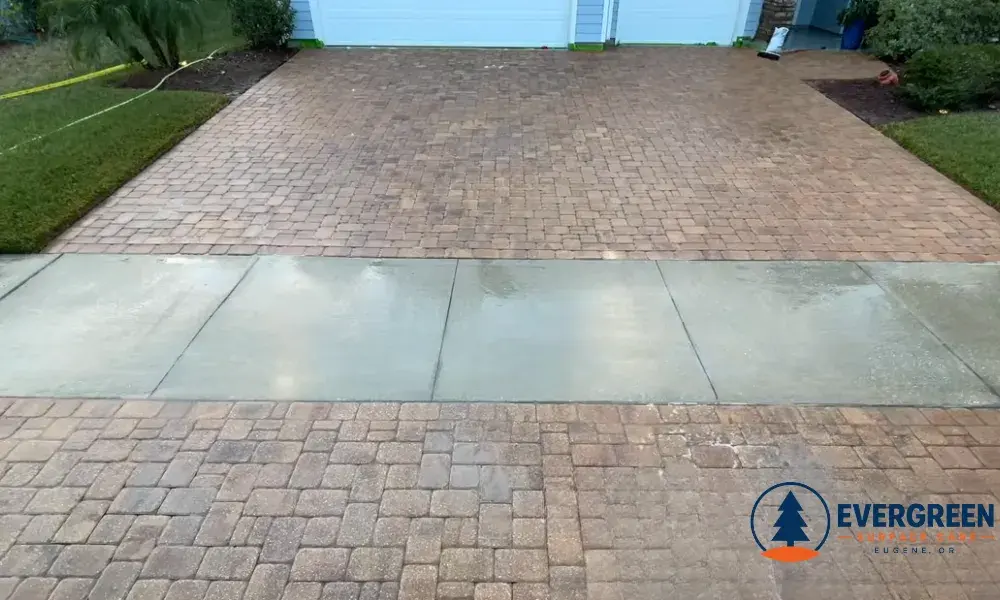
Identify the material, treat the stain, then rinse — in that order. Pretreat moss and algae and let the product dwell, clean with a wide fan tip held low and moving, keep concentrated pressure out of the joints, then inspect. Resand only if the joints actually need it, and seal only once the surface genuinely meets the sealer’s moisture and weather requirements.
Pressure moves water. Chemistry removes growth. Almost every ruined paver patio comes from reversing those two roles.
Rain, shade, wet leaves, soil, moss, algae and slow drying all leave their mark here. Eugene’s 1991–2020 normals put annual precipitation at 40.83 inches, with December alone averaging 7.21 inches against July’s 0.32. Add mild winters and you have close to ideal conditions for moss, which typically takes hold with the fall rains and peaks in early spring.
Pavers add a variable plain concrete does not have: the joints. Concrete pavers, brick, sandstone, limestone, slate, flagstone, travertine and granite all react differently to pressure and chemistry, and the sand holding a paver system together sits exposed between every unit. Clean too aggressively and a wash turns into a rebuild.
Sealing adds a third layer of decisions. Some surfaces benefit. Plenty do not need it at all. This guide covers how the work should actually be done, when resanding makes sense, when sealing helps, and what to ask before you hire anyone.
- 40.83 in Eugene annual precipitation normal
- 7.21 in December average, vs 0.32 in July
- 1.5 in Typical minimum joint depth for polymeric sand
- $150–350 Typical patio cleaning in Eugene
Why pavers and stone need different care here
A patio is almost never exposed evenly. One section gets six hours of summer sun; another sits under a Douglas fir beside a north-facing fence. The shaded half is always the half that changes first, usually months before the sunny side shows anything at all.
That shaded section is where moss forms in the low joints, where algae leaves a green film across the walking path, and where wet leaves sit long enough to stain. Soil from planters settles into textured surfaces and stays there.
What should be inspected before any water touches the patio
The method should match the material, not the property. One pressure setting dragged across an entire backyard is how good patios get damaged.
- Surface material and condition. Concrete paver, brick, or which natural stone specifically
- Existing joint sand. Type, depth and whether it is still stable
- Loose or rocking pavers, which point to a base problem rather than a surface one
- Failed or peeling sealer, because a new coating over a failing one produces cloudy patches
- Moss, algae and the stains you actually have — oil, rust and leaf tannin all need different chemistry
- Drainage, runoff path and nearby landscaping, decided before cleaning starts rather than during
- Shaded, slow-drying zones, which control the whole sealing timeline
If you want that inspection done properly, our patio and walkway cleaning in Eugene covers concrete, pavers, brick and natural stone.
Decide the scope before the washer comes out
This matters more than most homeowners expect, because these are four genuinely different jobs with different prices, timelines and risks.
- Cleaning only. Designed to disturb the existing joints as little as possible
- Cleaning plus a top-up of joint sand where it has gone low
- Cleaning plus full joint restoration, where the old material comes out to depth
- Cleaning, joint work and sealing, which needs several dry stages in sequence
The most expensive mistake in this trade
Starting with a pressure washer and deciding what to do about the joints afterwards. By then the decision has already been made for you, and it was made by a nozzle rather than by anyone looking at the patio.
Concrete Masonry & Hardscapes Association guidance notes that pressure washers are commonly used on concrete pavers, but warns operators against removing joint sand unnecessarily. Nozzle choice, distance, spray width and angle all change the outcome.
Can you pressure wash pavers without damaging them?
Yes. The control variables are pressure, spray pattern, distance and the angle at which water crosses the joints — not raw power. There is a large difference between cleaning the face of a paver and firing water straight down into the gap between two of them.
A concentrated nozzle held close will strip dirt fast and excavate joint sand just as fast. A wider fan gives the operator far more control, and CMHA guidance specifically notes that a wide spray covers more area while reducing the chance of washing sand out of the joints. Lowering the spray angle reduces disturbance further.
More pressure does not mean more cleaning. Most of what people are trying to remove responds to chemistry and dwell time instead:
- Moss and algae. Pretreatment and time to work, not force
- Oil. A degreaser and a separate process, covered in our guide to removing oil stains from concrete
- Rust. A targeted product; pressure will not touch it
- Efflorescence. A different approach entirely, and never more PSI
- Leaf tannin. Usually lifts with the right cleaner and almost never with pressure alone
A pressure washer moves water. It has no idea what caused the stain. The safe sequence is identify, treat, clean, then inspect.
How natural stone should be cleaned
Identify the stone before choosing any cleaner or pressure setting. Different minerals react very differently to acid, alkalinity, abrasion and water pressure, and this is where stone work genuinely departs from washing concrete.
What is under the dirt, and what it will tolerate
Note that “flagstone” describes a shape, not a mineral. Before treating it, someone has to work out what it actually is.
- Limestone and travertine. Calcareous. Acids etch them. Neutral cleaners only, and travertine’s open pores trap soil and debris
- Marble. Calcareous. Rare outdoors, but acids will dull and etch it just as fast
- Sandstone. Siliceous and often porous. Moderate pressure, wide fan, generous standoff
- Slate. Layered, and aggressive pressure delaminates it. Lift one flake and it keeps going
- Granite. Durable, but the joints, previous sealers and adjacent materials around it are not
The Natural Stone Institute recommends understanding a stone’s composition before selecting any cleaning product, and advises neutral cleaners, stone soap or mild detergent for routine cleaning. It specifically warns that lemon, vinegar and other acidic cleaners can dull or etch calcareous stone.
That warning applies outdoors too. A patio with heavy dark organic growth tempts people toward the strongest masonry cleaner on the shelf, and that is how a removable stain becomes permanent etching.
What efflorescence is, and when to leave it alone
Efflorescence is the white or grey mineral haze that appears on concrete pavers. It is not dirt, mould or fading, and it does not respond to more pressure. CMHA explains that it forms when calcium compounds migrate through the concrete and reach the surface, where evaporating moisture leaves a calcium carbonate deposit behind.
If your pavers are new, wait before you panic
Efflorescence is most common on recently installed pavers, and in many cases it fades on its own over the first year as free calcium works its way out and normal weathering wears the deposit down.
If your patio went in within the last twelve months and a white bloom has appeared, the right first move is often to leave it alone rather than pay someone to strip it. Still there after a full wet season? Then it is worth treating properly.
Efflorescence should always be resolved before sealing. Sealing over unresolved haze locks the problem under a coating, and correcting it at that point means stripping the sealer first. When the cause of a discoloration is uncertain, a small test area answers the question cheaply, and that one step has saved a lot of patios.
Do pavers need new sand after cleaning?
Sometimes. Resanding should follow from the joint condition after cleaning, not be bolted onto every quote automatically. A careful wash on a healthy patio may disturb very little. An older patio with already-failing sand can lose a great deal. Those two situations do not get the same scope.
-
Leave it
Joints stable and full
Stripping everything out just to replace it creates work nobody needed. Clean gently and stop.
The most common outcome.
-
Top up
Joints low in patches
Sand has washed out in the wet-season runoff path but the rest of the patio is sound.
Targeted, not wholesale.
-
Rebuild
Joint material has failed
Old material comes out to the depth the new product requires, then goes back in properly.
A separate job, priced separately.
Techniseal’s guidance for polymeric sand on existing installations states that joints being replaced must first be emptied to the required depth, and its guide specifies a minimum of about 1.5 inches for that system. Other manufacturers set different requirements, so always work from the technical data sheet for the actual product in use.
The broader lesson holds regardless of brand. You cannot dust a thin layer of new polymeric sand over failing material and expect it to behave like a rebuilt joint.
Polymeric sand versus conventional joint sand
-
Conventional
Regular joint sand
Lower stabilisation and weaker weed resistance, but very forgiving to install and it fails gradually rather than dramatically.
Washout is the failure mode.
-
Polymeric
Polymeric sand
Stronger joint stabilisation and better weed resistance when correctly installed, but depth, surface residue and water timing all have to be right.
Haze or crusting is the failure mode.
Residue on the paver face is the usual culprit
Techniseal warns directly that polymeric sand left on the surface can cause hazing after activation. In practice that residue and poor rain timing sit behind most of the polymeric failures we are called in to look at.
The patio has to be dry enough first, the faces have to be cleared of loose polymer before activation, and water has to be applied exactly as the manufacturer specifies. All three, not two of three.
The full process, start to finish
A clean-only job is one visit. A clean, sand and seal restoration spans several days, because each dry stage has to complete before the next one starts. Plan around the whole sequence rather than the cleaning appointment.
-
Identify the material and clear dry debris
Establish what you actually have — concrete paver, brick, or which specific stone — before any product is chosen. Then sweep and blow off leaves, soil and loose debris.
Dry removal first is also the runoff decision. Anything you sweep up now is something that never has to travel anywhere in wash water.
-
Inspect the joints and record what you find
Check depth, stability and how much material has already gone. Note any rocking pavers, because those are a base problem that cleaning will not fix and washing will hide.
This is what decides whether the job is a clean, a top-up or a rebuild, and it has to happen before the pressure decision, not after it.
-
Pretreat and let the product dwell
Moss, algae and organic staining need contact time. Apply the appropriate cleaner for the material, keep the surface wet, and let it work.
Every minute cut from dwell time gets paid back in pressure later, and pressure is the thing costing you joint sand.
-
Clean with a wide fan, low angle, always moving
Wide spray pattern, generous standoff, low angle across the joints, and the wand never stationary. Work in consistent passes so you do not leave start and stop lines.
Test a hidden area first on natural stone or any surface you are unsure about, and let it dry fully before judging the result. Wet stone lies about everything.
-
Reinspect, then resand only if needed
Look at the joints again now that the growth is gone. If they are full and stable, you are done. If not, sweep in new material, compact if the system calls for it, clear every trace of residue from the paver faces, then activate per the label.
The residue step is not optional. It is the difference between a clean patio and a hazed one.
-
Dry properly, then decide about sealing
A patio can look bone dry on top while joints and porous material still hold water. Shade slows it further, and so do cool temperatures.
Meet the sealer’s published moisture, temperature and weather requirements, or postpone. Sealing is the easy part once everything before it was done right.
Should every paver patio be sealed?
No. Sealer can add real stain resistance and change appearance, but it should be chosen for a specific reason rather than treated as mandatory maintenance. It is not armour.
On concrete pavers, a compatible product may reduce absorption, make routine cleaning easier, enrich colour and help stabilise certain joint systems. It will also change sheen and colour, which you may or may not want. Before anyone quotes a sealer they should ask what finish you are after, because the answer changes the product.
Ask directly whether a “clean and seal” package includes joint work. Cleaning, resanding and sealing are three separate operations even when one crew does all three in one visit.
Does natural stone always need sealer?
Also no. The Natural Stone Institute draws an important distinction here: many products sold as stone sealers are impregnating repellents, which make stone more resistant to staining rather than stain-proof. What sealing buys you is reaction time and easier maintenance, not immunity from spilled grease or leaf tannin.
The Institute also notes that some stones simply do not require sealing, that topical coatings can alter texture and appearance, and that leaving stone untreated is sometimes the better call. Nobody should arrive at a natural stone patio with one sealer intended for all of them.
What goes wrong when pavers are sealed too soon
The finish usually gets blamed. Preparation is usually the actual cause.
- Moisture still held in porous pavers or in joints that looked dry from above
- Residual polymeric sand left on the paver face before activation
- Efflorescence that was never removed, now permanently under a coating
- Old sealer left underneath a new and incompatible one
- Uneven or excessive application, which cures to a patchy sheen
- Applying in unsuitable weather, especially with rain inside the cure window
- Sealing over stains that were never actually resolved
Once a coating cures badly, fixing it usually means stripping it, which is far harder than the original cleaning ever was. So the least interesting part of the project decides the result. A good clean-and-seal job should look almost boring right before the sealer comes out. Surface clean. Joints correct. Pavers dry. Weather settled.
Wet look or natural look?
-
Natural
Matte and natural-look
Keeps the patio close to how dry stone reads. Less dramatic, easier to live with, and harder to regret.
Safer on natural stone.
-
Enhanced
Wet-look and enhancers
Deepens colour and lifts faded concrete pavers. On stone it also exaggerates veining, mineral variation and dark patches.
Test before you commit.
Always test an inconspicuous area on your actual material. A product label tells you nothing about how it will look on your patio, and this is a decision that stays with you for years.
The right window for this in Eugene
Cleaning is flexible and can happen whenever temperatures and site conditions are reasonable. Sealing needs a dependable dry stretch. Late spring through early fall gives the most reliable windows here; winter sealing is sometimes possible, but the margin for error gets thin fast.
One local detail worth planning for. The City of Eugene is clear that material washed off hard surfaces can reach the stormwater system and local waterways. Its pressure washing guidance notes runoff may carry sediment, grease, vehicle fluids, soaps and cleaning chemicals, and that stormwater can reach the McKenzie and Willamette Rivers without the treatment applied to sanitary wastewater.
On a patio surrounded by lawn this is easy, because gravity already does what the code wants. On a patio that drains onto a driveway sloping to the street, berm the edge and direct the water into landscaping instead.
Sources for this section: NOAA and NWS Eugene precipitation normals for the rainfall figures, and the City of Eugene’s stormwater and water quality guidance for the runoff requirements above.
How often should a patio be cleaned?
There is no universal interval. A sunny patio with good drainage can stay presentable for years; a shaded patio under mature maples greens up again within a season. Watch the patio, not the calendar.
- Moss starting along walls or in the paver joints
- Green algae across shaded walking areas
- Leaf staining around furniture and planters
- Joints sitting noticeably low against the paver faces
- Weeds establishing in the gaps
- Water no longer beading on previously sealed stone
- Heavy soil collecting along borders and bed edges
The goal is not frequent pressure washing. Good maintenance reduces how often aggressive restoration is needed at all — sweep leaves before they break down, move planters occasionally, keep mulch and soil off paver edges, rinse fresh spills, and watch how water behaves after heavy rain. Small habits go a long way in western Oregon.
What this costs, done yourself or done for you
Our patio cleaning service runs $150 to $350 for most residential patios and walkways. The spread comes from square footage and access, material, how established the growth is, and how much staining is involved. Joint replacement and sealing are separate work with separate material cost.
DIY makes perfect sense on a small, stable patio with light buildup. Light dirt on sound concrete pavers does not need a professional, and we would rather say that than sell you something you do not need. The risk climbs sharply when you have:
- Natural stone you cannot confidently identify, where the wrong cleaner etches permanently
- Failed or unknown existing sealer, which needs stripping rather than cleaning
- Heavy efflorescence on a patio past its first year
- Deep oil or rust staining that needs targeted chemistry
- Loose pavers or low joints across a meaningful part of the surface
- Substantial polymeric sand replacement, where depth and timing decide everything
- Storm drains close by, a steep grade, or delicate planting at the edges
Most DIY problems start with the assumption that pressure alone will solve it. Then the joint sand disappears, or the stain stays, or polymeric haze appears, or the coating changes the colour. The skill is recognising the point where the patio has stopped being a basic washing project.
Book it as one visit and save the trip
The growth on your patio is almost never confined to the patio. If the joints have moss, the fence beside them usually does too. Bundling deck cleaning, fence cleaning in Eugene or driveway cleaning into the same appointment costs less than booking each one separately.
One ordering note that saves a repeat job: always work top down. Runoff from house washing lands on whatever is below it, so the patio should be the last surface you touch.
How to choose a paver or stone cleaning company
The first conversation tells you most of what you need to know. Be cautious if every answer comes back to PSI.
Nine questions that separate the surface from the depth
A contractor who can answer these comfortably has thought about your patio specifically rather than about their equipment.
- What happens to the joint sand during cleaning?
- How do you identify natural stone before choosing a product?
- Do you use acidic cleaners, and on which surfaces?
- Is resanding included, and what makes you decide either way?
- Is sealing included, and which specific product?
- How long does the patio need to dry before that sealer goes down?
- What happens if rain enters the forecast mid-job?
- How are the surrounding plants protected?
- Where does the wash water end up?
A good contractor should also be willing to tell you a specific stain may not come out completely. Realistic expectations are a good sign. So is a written scope that separates cleaning, joint work and sealing into distinct line items.
FAQs About Cleaning and Sealing Pavers and Stone
Should I pressure wash my paver patio?
Usually yes, if the pavers are sound. The operator needs to control pressure, distance, nozzle type and spray angle, because concentrated pressure inside a joint removes sand quickly. Inspect the joints before you start rather than after.
Do pavers need resanding every time they are cleaned?
No. It depends on joint condition after cleaning. A careful wash may disturb very little. Full restoration requires deeper removal and replacement, and polymeric sand must follow the manufacturer’s depth, compaction, activation and curing instructions.
Is polymeric sand better than regular joint sand?
It offers stronger joint stabilisation when the paver system and installation are compatible, but it is far less forgiving. Insufficient joint depth, residue left on the paver face, or incorrect watering can cause haze or outright failure.
Can natural stone be cleaned with vinegar?
Do not treat vinegar as a universal stone cleaner. The Natural Stone Institute warns that acids etch calcium-based stones such as limestone, travertine and marble. Identify the stone before choosing any cleaning chemistry.
Does natural stone have to be sealed?
No. Some stone benefits from an impregnating sealer and some performs better untreated. Sealing increases stain resistance rather than making stone stain-proof, and topical coatings can change texture and appearance.
How long should pavers dry before sealing?
There is no universal number. Follow the sealer’s technical data sheet. Porosity, shade, temperature, humidity, recent rain and joint material all change drying time, and a patio can look dry on top while the joints still hold moisture.
Why did my pavers turn white after sealing?
Likely causes are trapped moisture, unresolved efflorescence, polymeric residue left on the paver face, incompatible old sealer underneath, excess coating, or poor curing conditions. Diagnose the cause before applying anything else over it.
Is white haze on new pavers a problem?
Often not. Efflorescence is most common on recent installations and frequently fades over the first year as free calcium works out of the concrete. If it is still there after a full wet season, it is worth treating properly.
Does sealing stop weeds between pavers?
It helps. Sealer and correctly installed jointing material reduce the conditions weeds need, but they do not guarantee a permanently weed-free patio. Soil and seeds still collect in joints over time.
What is the best season for paver sealing in Eugene?
A dependable dry stretch with suitable surface temperatures matters more than any specific month. Eugene averages 0.32 inches of rain in July against 7.21 inches in December, so late spring through early fall gives the most reliable drying and curing windows.
Can moss make a patio slippery?
Organic growth creates a slick surface when wet. Removing moss and algae improves normal walking conditions, though cleaning cannot correct poor drainage, uneven pavers or structural problems underneath.
Should I hire someone or clean the patio myself?
DIY works for a small, stable patio with light buildup. Professional help earns its cost when natural stone, damaged joints, existing coatings, strong stains, polymeric sand replacement, drainage concerns or sealing are involved.
Cleaning first, sealing second
A clean patio is not automatically ready for sealer. That single idea prevents most of the expensive mistakes in this trade.
Cleaning reveals the real condition of the surface. You may find weak joints, old coating failure, permanent discoloration that looked like dirt, efflorescence hidden under growth, or colour variation in stone nobody has seen in years. That information should shape the next decision — and often the right answer is to clean the patio and stop there.
Good exterior maintenance is not about selling the longest list of services. It is about doing what the material actually needs, and being willing to say when that is less than you were expecting.
Get the Patio Clean Without Creating the Next Repair
Tell us the patio size, whether it is concrete, pavers, brick or stone, and what is growing on it. We will tell you what it needs — and say plainly when the answer is cleaning alone.
Evergreen Surface Care provides pressure washing Eugene, OR and nearby Lane County. Free written estimate. Surface-matched methods. No surprise charges.