
Deck Care Decision Guide · Eugene, OR
When to Clean vs. Restain a Eugene Deck: The 2026 Decision Guide
A green or weathered deck does not automatically need another coat. In Eugene, the better decision comes from finish condition, water absorption, wood moisture, and the weather window.
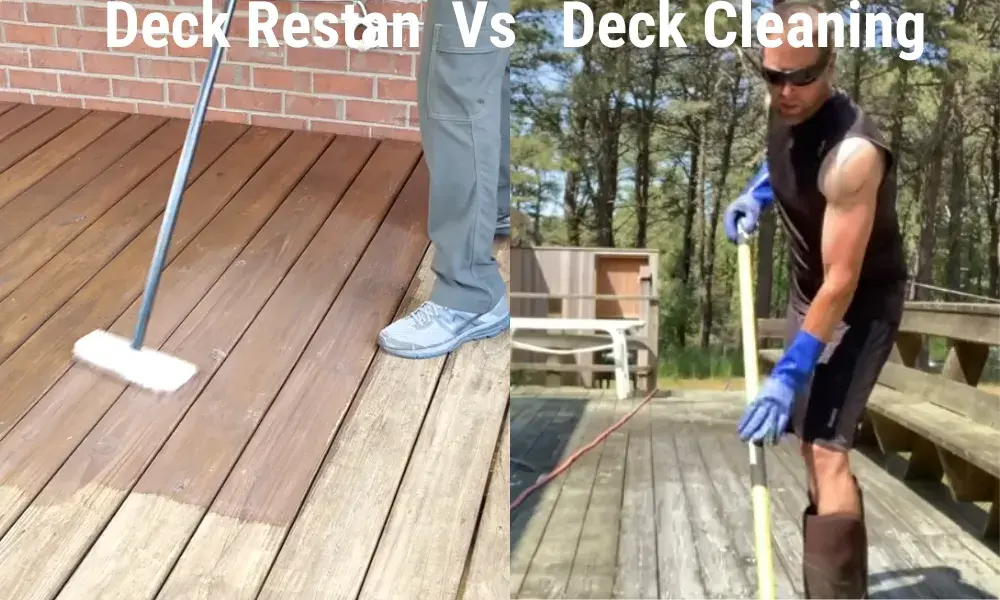
Clean when the existing finish is still sound but dirt, algae, moss, pollen, leaves, or surface weathering make the deck look tired. Restain when the finish no longer repels water or has worn away enough to expose the wood. Peeling or flaking coatings may need stripping, sanding, brightening, and refinishing instead of a simple maintenance coat.
- Water beadsA strong sign that cleaning may be enough
- Water soaksA sign the finish may be losing protection
- 24–72 hrCommon starting dry-time range before stain, weather permitting
- May–SepMost dependable Eugene refinishing window in the article
A Eugene deck can look terrible in March and still not need another coat of stain.
That sounds backward, but it matters.
Months of rain, fir needles, shade, moss, algae, and tracked-in dirt can make sound wood look years older. Yet the finish underneath may still repel water perfectly well. In that case, another coat of stain adds cost without solving the real problem.
The opposite mistake costs even more.
Some decks look only dirty, but their protective finish has already failed. Water disappears into the boards. Traffic paths have turned pale. The grain feels rough. Old solid stain may be peeling at the edges.
Cleaning will improve how that deck looks. It will not restore the protection that has worn away.
So, when should you clean vs. restain a Eugene deck?
The answer should come from the deck, not the calendar. Look at the material, coating condition, water absorption, wear patterns, and upcoming weather.
That last factor matters more here than in many parts of the country. Nearly 90 percent of Eugene’s annual rainfall falls between early October and mid-May. July and August receive only a small portion of the yearly total.
That gives Eugene homeowners a fairly short window for washing, drying, and refinishing exterior wood.
This guide shows you how to tell what your deck actually needs before you spend money on the wrong job.
For the local cleaning process itself, see our guide to deck cleaning in Eugene.
Should You Clean or Restain Your Eugene Deck?
Here is the fastest answer.
Clean your deck when the existing finish is still sound, but dirt, algae, moss, pollen, leaves, or surface weathering have made it look tired. Restain when the finish no longer repels water or has worn away enough to leave exposed wood.
If the coating is peeling or flaking, you may need more than a maintenance coat. That can mean stripping, sanding, brightening, and refinishing.
There is one rule I would put above every “restain every two years” recommendation on the internet:
Two decks built on the same day can age very differently. One may sit beneath Douglas firs in the South Hills. Another may get full afternoon sun in Santa Clara. One sees daily foot traffic. The other barely gets used.
Do not buy stain just because a date on the calendar says it is time.
Clean a small area first. Let it dry. Then inspect what is actually underneath.
If an existing stain still repels water, the finish may still be performing and cleaning may be all that is needed.
Why Does Eugene’s Climate Change Deck Maintenance?
Eugene is wet for a long stretch of the year.
That is obvious to anyone who lives here, but its effect on wood is easy to underestimate.
Horizontal deck boards hold moisture longer than vertical siding. Fir needles settle into gaps. Leaves trap moisture against the surface. North-facing sections may stay shaded long after sunny boards have dried.
The result is a perfect environment for moss and algae.
That means a green Eugene deck is not automatically an unprotected deck. Sometimes you are looking at biological growth sitting on top of a perfectly serviceable finish.
Eugene decks under heavy tree cover can collect significant moss, algae, dirt, and organic buildup even while the coating beneath remains intact.
Explore the broader surface-matched pressure washing services we use around Eugene if other exterior surfaces show the same wet-weather buildup.
There is another local issue.
Wood needs to dry before stain goes on.
Western Oregon’s fall and winter humidity can make effective air drying difficult. Wood may regain moisture from rain and humid air during those months.
That is why forcing a refinishing project into November can turn a simple maintenance job into a gamble.
What Signs Mean Your Deck Only Needs Cleaning?
A deck usually needs cleaning rather than restaining when the protective finish still works.
Look for contamination rather than coating failure.
Common examples include:
- Moss between boards
- Green algae
- Pollen
- Bird droppings
- Muddy footprints
- Leaf tannins
- Fir needles
- Ordinary grime
The strongest clue is how the deck behaves around water.
Once the boards are dry, place a little water on several areas.
Do not test only one convenient board. Check a sunny area, a shaded area, stair treads, and a high-traffic path.
If the water beads or remains on top for a while, the existing finish is still resisting moisture.
Cleaning may be enough.
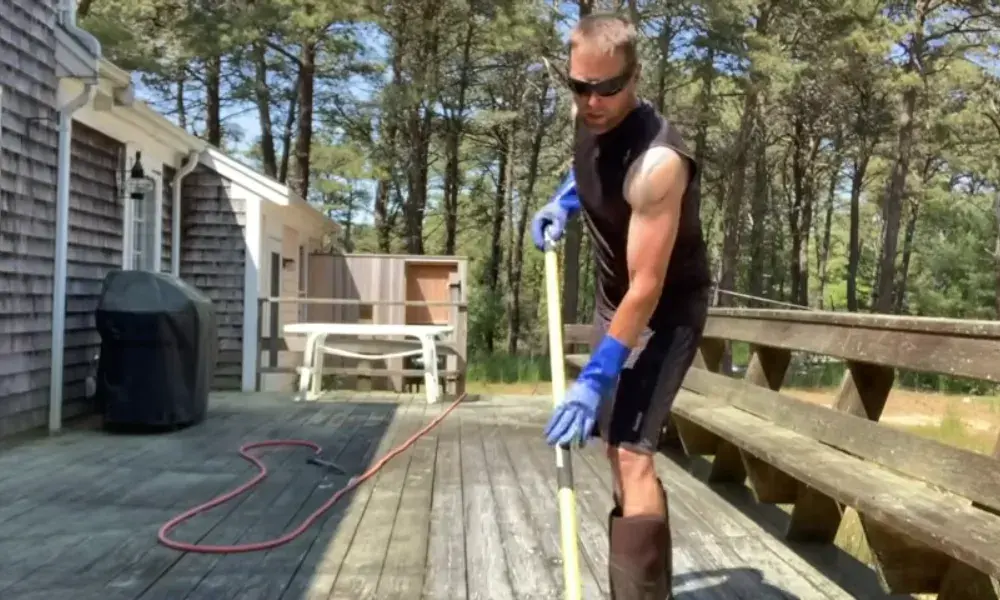
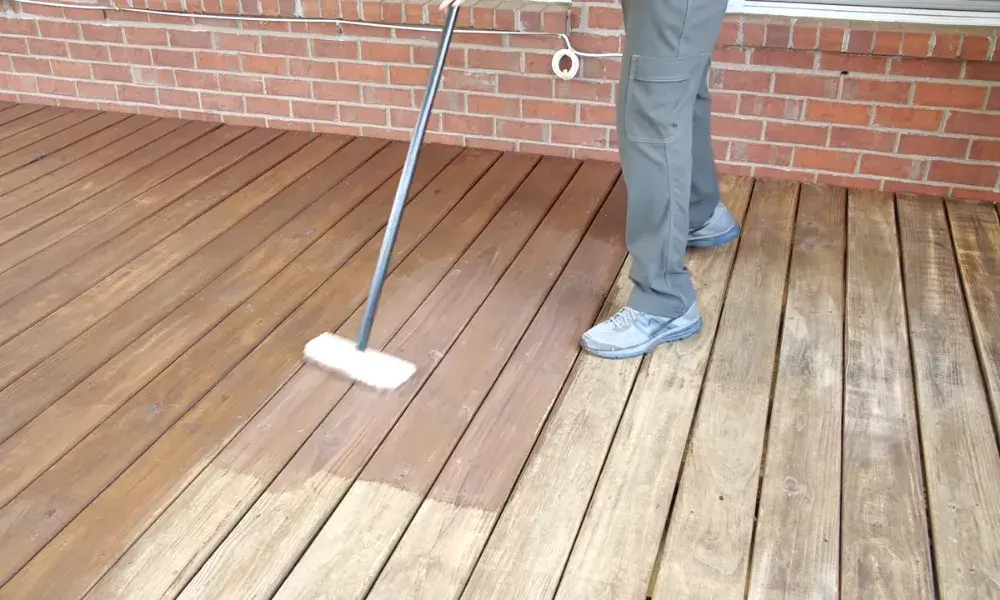
Another useful test is a small cleaning patch. If a dull board becomes even and attractive again after the growth comes off, you may simply have a dirty deck.
Heavy moss, algae, dirt, and surface buildup can make weathered boards look much worse than they really are. Once that contamination is removed, the underlying wood can appear substantially brighter.
That is why diagnosis should come before refinishing.
What Signs Mean It Is Time to Restain?
Restaining makes sense when the finish stops protecting the wood.
Watch for these changes:
- Water quickly disappears into the grain
- High-traffic paths have faded to exposed wood
- Color has worn unevenly across horizontal boards
- Wood feels dry, coarse, or unusually rough
- The deck darkens immediately when wet
- Old solid stain is peeling, cracking, or flaking
- Bare patches are appearing around furniture and stairs
Penetrating stains often fade instead of peeling. That makes them easier to maintain, but you still need to watch for lost water resistance.
Exterior stains help protect wood from sunlight and moisture. Penetrating stains are also less prone to cracking and peeling than film-forming finishes such as paint.
Solid stains behave differently.
If a film-forming coating is peeling, adding another coat can simply cover a weak layer that is already letting go.
A simple tape test can help with those finishes. Press tape firmly onto the surface and remove it. If loose coating or wood fibers come away, more preparation is needed before recoating.
Stain should restore protection.
It should never be used to hide failed preparation.
How Do You Perform the Water Drop Test Correctly?
The water test is useful because it measures performance rather than age.
Start with a dry deck.
Do not test the morning after rain. Do not test immediately after washing.
Choose several locations.
Place a small amount of water on each one and watch what happens.
If droplets bead, the surface still has meaningful water repellency.
If the water spreads, darkens the wood, and absorbs quickly, that section has become more porous.
Now compare several boards.
A deck rarely wears at exactly the same rate everywhere. Stair treads take punishment. The path between a sliding door and yard may fade first. Exposed boards can get stronger UV damage while shaded boards remain damp longer.
That uneven wear is why one water drop is not enough.
Use the test together with visual inspection and coating condition.
Does the Type of Existing Stain Matter?
Very much.
A penetrating semi-transparent stain normally wears away gradually. If it is compatible with the existing finish, a cleaned and properly prepared deck may only need a maintenance coat.
A solid stain forms more of a surface layer. Once that layer begins peeling, simply covering it with fresh material may repeat the problem.
Paint is more demanding again. Peeling paint may require scraping and sanding before another coating can bond reliably.
If you do not know what is on your deck, inspect a protected edge.
Penetrating stain usually leaves the grain clearly visible.
Solid stain hides much more of the grain.
Paint tends to produce the thickest film.
Do not switch products blindly. Manufacturers can have very different preparation requirements.
This is one reason product choice should come after you understand the existing finish.
Not before.
When Does Deck Cleaning Turn Into Full Restoration?
Cleaning removes contamination.
Restoration deals with failed wood surfaces and coatings.
That difference can represent hundreds or thousands of dollars.
Many Eugene deck-cleaning projects may fall in the $175 to $450 range. Heavy moss, multiple levels, large railing systems, failing finishes, and difficult access can increase the price.
Full deck restoration can cost much more depending on the condition and scope.
The cheapest path is not automatically the smallest quote.
It is the least invasive process that properly solves the problem.
If cleaning exposes sound, evenly protected boards, stop there.
If cleaning reveals alternating areas of bare wood and intact coating, the deck may need refinishing.
If the coating is peeling everywhere, pressure washing harder is not the answer.
That is especially important with cedar.
Trying to blast stain off soft wood can remove coating and damage wood fibers at the same time.
You have technically stripped something.
Unfortunately, part of it was the deck.
How Long Should a Deck Dry After Cleaning Before Staining?
There is no reliable universal clock.
Use elapsed time, weather conditions, and moisture together.
Many stain manufacturers recommend allowing cleaned wood to dry for at least 24 to 72 hours before staining.
A Eugene deck can easily need longer.
Shade matters.
Humidity matters.
Wood species matters.
A shower during the drying period matters.
The surface may feel dry while deeper fibers still contain too much moisture.
A moisture meter is much more useful than guessing.
Some stain systems call for wood around 15 percent moisture content or lower before coating. Always use the actual product requirement because acceptable readings differ.
Wagner and Lignomat are two established moisture-meter manufacturers.
Waiting another dry day is frustrating.
Removing failed stain next year is worse.
What Is the Best Season to Restain a Deck in Eugene?
Cleaning has a broad season.
Staining does not.
Late spring is often a good time to remove winter moss and organic growth. If the deck only needs cleaning, that gets the space ready for summer without committing you to refinishing.
For staining, the most dependable Eugene window usually falls from late May through mid-September.
July and August give you the best statistical chance of sustained dry weather because Eugene receives very little of its annual rainfall during those months.
The exact day still depends on your product.
Many deck stains require temperatures somewhere around 40°F to 90°F or 50°F to 90°F, depending on the formula. Manufacturers also commonly warn against staining when rain is expected within the next 12 to 24 hours.
Different products have different windows.
So another rule belongs here:
Plan around the weather.
Not around the first Saturday you happen to have free.
Can Pressure Washing Damage a Wood Deck?
Wood is not concrete
More pressure does not mean better deck cleaning. Soft or weathered boards can fur, stripe, or partially strip before the damage is obvious.
Yes.
More pressure does not mean better deck cleaning.
Wood is not concrete.
Cedar, redwood, Douglas fir, and pressure-treated lumber have different densities and weather differently. Old boards may also lose surface strength.
A good cleaner should do much of the work before water pressure enters the equation.
Evergreen Surface Care uses a surface-matched approach rather than one pressure setting across an entire property. Deck cleaning should use lower pressure on softer and older wood.
One common pressure-washing failure is “furring.”
The board dries and feels fuzzy because soft fibers have been lifted.
Another is partial stripping. High pressure removes stain from one area but leaves it intact nearby. The next stain coat absorbs unevenly and looks blotchy.
If removing a coating requires damaging pressure, change the preparation method.
Do not increase the PSI.
What About Trex, TimberTech, and Other Composite Decks?
Composite changes the clean vs. restain decision.
Most modern composite and PVC decks need cleaning.
They do not need ordinary wood stain.
Trex decking can generally be maintained with soap and water or an appropriate gentle cleaning method.
TimberTech also provides specific cleaning and pressure-washing limits for its composite and PVC products.
Material identification should therefore come before every other test.
Do not apply a cedar maintenance routine to a Trex board simply because both surfaces have a wood-grain pattern.
That mistake can get expensive quickly.
Which Deck Products and Tools Are Worth Knowing?
The best product is not always the most expensive can on the shelf.
It is the one that matches the deck, old coating, preparation method, and weather window.
| Product or Tool | Best Use | Important Limitation |
|---|---|---|
| Wagner moisture meter | Checking wood before stain | Read several locations |
| Lignomat moisture meter | Moisture verification | Follow species and meter guidance |
| Sodium percarbonate cleaner | Organic buildup on many wood decks | Use proper dilution |
| Oxalic acid brightener | Brightening and some iron-tannin staining | Not a substitute for cleaner |
| Cabot | Multiple stain opacity choices | Prep and dry time matter |
| Sherwin-Williams SuperDeck | Exterior wood finishing | Match product to existing coating |
| DEFY | Penetrating wood-stain systems | Maintenance prep still matters |
| TWP | Penetrating exterior wood finish | Wood moisture and weather matter |
| Armstrong Clark | Oil-based penetrating stain | Old coatings may require removal |
| Behr DeckPlus | Solid waterproofing stain | Overapplication can cause failure |
| Trex care products | Composite maintenance | Follow the exact Trex product |
| TimberTech DeckCleaner | TimberTech composite and PVC | Do not let cleaner dry on the surface |
Manufacturer guidance consistently comes back to the same boring truth.
A premium stain cannot rescue wet wood, algae, loose fibers, or a failed coating.
Does Eugene Have Rules About Deck-Cleaning Runoff?
Plan where the wash water goes
Deck cleaner, loosened dirt, coating residue, and contaminated wash water should not be treated like ordinary rainwater.
Yes, and this part gets missed in a lot of generic deck articles.
The City of Eugene generally prohibits discharging substances other than stormwater into the city stormwater system without authorization.
City pressure-washing guidance also addresses collecting and properly directing wash water from cleaning activities.
The practical lesson is straightforward.
Do not assume deck cleaner, loosened dirt, coating residue, or contaminated wash water can simply run down a driveway into the nearest storm drain.
Runoff planning matters for your property.
It also matters for local waterways.
Three Eugene Deck Scenarios That Make the Decision Easier
Scenario 1: A Shaded Cedar Deck in the South Hills
The boards are green by April. Stairs feel slick. After one test patch is cleaned, the cedar looks much better. Water still beads across most boards.
That deck probably needs cleaning, not another coat of stain.
Scenario 2: A Pressure-Treated Deck in Santa Clara
The surface is dirty, but the bigger clue appears after cleaning. Water immediately darkens the floorboards. The rail still beads water, but traffic paths do not.
That deck is moving toward a maintenance coat. Clean and prepare it properly, let it dry, verify moisture, then follow the chosen stain system.
Scenario 3: An Older Solid-Stain Deck Near River Road
Several boards are peeling at their edges. Furniture legs have exposed bare patches. Tape pulls loose material away.
Cleaning alone will not fix that.
Another coat over the top may only hide the problem temporarily. Loose coating needs to be addressed before refinishing.
Those examples show why “dirty,” “old,” and “needs stain” are not synonyms.
What Other Wet-Weather Maintenance Should Eugene Homeowners Check?
A mossy deck often tells you something about the rest of the property.
If fir needles are collecting on the deck, they may also be filling the gutters.
If roof moss is visible above the same shaded side of the house, treat it as a separate surface problem.
The same goes for algae on siding. Different exterior materials require different cleaning methods.
The pattern is consistent.
That is especially important in Eugene, where damp conditions can create similar-looking organic growth across decks, siding, roofs, concrete, and walkways.
A Five-Minute Clean vs. Restain Test
Run through this process before buying stain.
- Identify the material. Composite normally gets cleaned. Wood moves to the next step.
- Check the structure. Soft boards, serious rot, loose rails, and failed fasteners need repair before cosmetic work.
- Look at the finish. Dirt and moss point toward cleaning. Bare wear paths and failed coating point toward refinishing.
- Clean one test area. You cannot diagnose a surface you cannot see.
- Let the test patch dry. Then perform the water test in several places.
- Watch the water. Beading suggests the finish is still working. Fast absorption suggests protection is fading.
- Check coating stability. Peeling solid stain may require stripping or sanding.
- Check moisture before staining. Do not trust touch alone.
- Read your stain label. Temperature and rain windows vary by product.
- Choose the least invasive correct fix. Cleaning is enough when the finish works. Restain when protection is failing.
The most important step is number four.
Do not decide what the deck needs while moss and grime are hiding the evidence.
FAQs About when to clean vs restain a Eugene deck
How often should I clean my deck in Eugene?
How often should I restain a Eugene deck?
Can I stain a deck without cleaning it first?
Should I pressure wash before staining?
How long after cleaning can I stain?
What if water beads on some boards and absorbs into others?
Can I stain over old solid stain?
Can you stain composite decking?
What happens if it rains after I wash the deck?
Does deck cleaning remove old stain?
Does gray wood automatically need stain?
Is moss proof that my deck is rotten?
When Should You Call a Eugene Deck-Cleaning Professional?
DIY cleaning can make sense on a small, structurally sound deck with light buildup and simple drainage.
Professional help becomes more useful when the deck is elevated, heavily mossed, made from soft cedar, badly weathered, coated with a failing finish, or surrounded by drainage conditions that complicate wash-water control.
You should also be able to ask a contractor one simple question:
“Does this actually need refinishing?”
A good answer may be no.
Evergreen Surface Care focuses on matching the cleaning method to the wood species, deck age, composite manufacturer requirements, and surface condition.
If you already plan to stain afterward, say so before the cleaning begins.
Prep affects what happens next.
The Bottom Line on When to Clean vs. Restain a Eugene Deck
The best Eugene deck-maintenance schedule is not “restain every two years.”
It is this:
If the boards are green but water still beads, clean them.
If water absorbs quickly and traffic areas have worn pale, clean and prepare the deck for a maintenance coat.
If the existing coating peels or flakes, deal with the failed finish before adding another layer.
And if the deck is composite, stop thinking about wood stain altogether.
Eugene’s wet climate makes timing important, but it also makes diagnosis important. Moss can make good finish look bad. Cleaning can reveal what you actually have.
Use the dry season. Check the wood. Check the forecast. Read the product label.
A few minutes spent making the correct clean vs. restain decision can prevent a weekend of unnecessary sanding later.
For a written deck-cleaning quote, call or text Evergreen Surface Care at (541) 603-0340.
Find Out What Your Deck Actually Needs Before You Refinish It
If the deck is green, weathered, slippery, or uneven, cleaning can reveal whether the existing finish still protects the boards. We can explain the cleaning approach and give you a clear written estimate.
Evergreen Surface Care provides pressure washing in Eugene, OR with surface-specific methods for decks, siding, roofs, concrete, gutters, patios, fences, and other exterior materials.