
Commercial Scheduling Guide · Eugene, Oregon
How to Schedule Commercial Pressure Washing Without Disrupting Your Business
The best commercial cleaning schedule protects customers, staff, deliveries, access, drainage, and reopening time. The quietest hour is not always the safest hour.
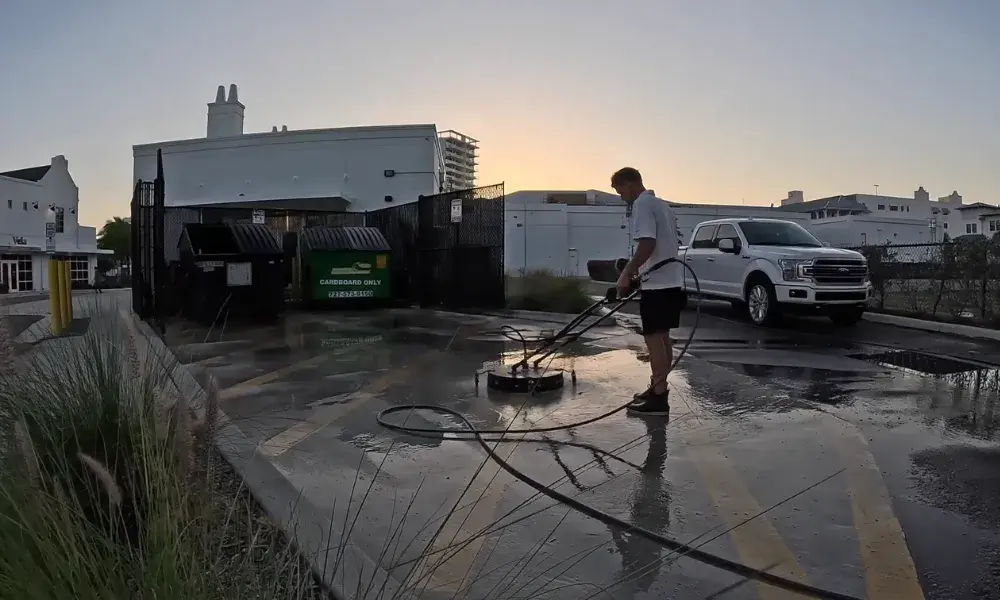
The cleaning crew arrives at 8:30 on a busy weekday morning.
Hoses cross the main entrance. A delivery truck needs the loading area. Customers step around cones. The concrete is still wet when lunch traffic starts.
The surface may end up clean.
The job still failed.
Commercial exterior cleaning is not only a cleaning problem. It is an operations problem.
The best schedule protects customers, employees, tenants, deliveries, parking, drainage, and reopening time.
That matters in Eugene.
Wet weather can narrow the best cleaning window. Shaded concrete can dry slowly. Restaurants, offices, stores, apartment communities, warehouses, and medical properties also have very different traffic patterns.
Scheduling commercial pressure washing around business hours works best when the contractor studies the property before choosing a start time.
The quietest hour is not always the safest hour.
This guide explains how to create a practical cleaning window without turning normal business operations upside down.
- 4 windowsEarly morning, after closing, overnight, or weekend work
- 7 stepsA practical scheduling checklist from site walk to documentation
- 3 projectsReal published examples using overnight or phased commercial work
- 24-hour sitesUsually need zone-based access rather than a full closure
Choose the cleaning window from the property’s real traffic pattern, not only its posted business hours. Map entrances, deliveries, parking, drains, and employee arrival. Divide large sites into zones and leave enough time for rinsing, inspection, wastewater control, and drying before reopening.
What Is the Best Way to Schedule Commercial Pressure Washing?
Scheduling commercial pressure washing around business hours starts with five decisions. Identify the quietest operating window, map access points, divide the work into zones, allow enough reopening time, and create a backup plan.
Start with these steps:
- Identify the property’s real low traffic period.
- Map entrances, parking, deliveries, drains, and water access.
- Divide the property into zones that can reopen separately.
- Leave enough time for rinsing, inspection, and drying.
- Create a backup plan for weather or access problems.
For many storefronts and offices, early morning service works well. Restaurants may prefer work after closing. Large parking structures may require several overnight shifts.
A 24 hour property needs something different. The contractor may clean one section while keeping another route open.
The business should not have to work around the pressure washing crew. The cleaning plan should work around the business.
For an overview of services, surfaces, and commercial cleaning methods, see our commercial pressure washing in Eugene service.
Why Does Commercial Pressure Washing Timing Matter So Much?
A clean sidewalk has little value if cleaning blocks the main entrance during peak customer traffic.
Poor timing can create several problems at once. Hoses may cross walkways. Wet concrete can reduce traction. Spray can reach parked cars. Noise may disturb tenants. Delivery vehicles can block the work area.
Employees may also arrive before the surface is ready.
Opening time is not the whole schedule
A restaurant may receive food deliveries two hours before opening. A medical office may have staff arriving long before the first appointment. An apartment walkway may stay active all night.
A site visit reveals details that do not show up on a map. Those small details often decide whether the job runs smoothly.
For Eugene properties, weather adds another layer. Shaded surfaces can remain damp longer, while moss and algae often favor low sun areas.
Our guide to moss, algae, and lichen on Eugene properties explains why the type of growth and the surface below it both matter.
What Time of Day Is Best for Commercial Pressure Washing?
The right cleaning window depends on customer traffic, employee arrival, deliveries, nearby residents, lighting, security, drying time, and how quickly each work zone must reopen.
Early Morning Cleaning
Early morning service works well when the property opens later. Crews can clean entrances and sidewalks before public traffic starts. Natural light also makes final inspection easier.
The common mistake is using the official opening time as the first arrival time. A store that opens at 9:00 a.m. may have employees arriving at 7:00.
After Closing
After closing works well for many restaurants, stores, and offices. Outdoor furniture can be moved, customer traffic has ended, and entrances can be cleaned without routing people around equipment.
The main concern is drying time. Finishing the last rinse five minutes before the crew leaves may not leave enough time for the surface to dry before morning.
Overnight Cleaning
Overnight work often makes sense for parking garages, shopping centers, entertainment venues, and other busy sites. It creates a longer work period with less public traffic.
However, overnight service raises new questions. Who unlocks the gates? Will nearby residents hear equipment? Will building alarms activate? Is there enough lighting? Who answers the phone if access changes?
Weekend Cleaning
Weekends can work well for offices, professional buildings, clinics, schools, and some industrial properties.
However, churches, restaurants, entertainment venues, and mixed use developments may become busier on weekends.
Scheduling commercial pressure washing around business hours means following the property’s real traffic pattern rather than choosing a standard time.
How Should You Map Customer and Vehicle Traffic?
Start with movement, not square footage.
Walk through the property during a normal workday when possible. Watch where customers enter. See where staff park. Find the delivery route. Note where trash trucks stop. Locate accessible entrances and ramps.
Then inspect the physical cleaning area.
- Main entrances
- Secondary entrances
- ADA access routes
- Loading docks
- Drive through lanes
- Dumpster areas
- Outdoor seating
- Parking rows
- Fire lanes
- Storm drains
- Water connections
- Electrical equipment
- Automatic doors
- Security gates
- Public sidewalks
- Landscaping
A small store may have one critical entrance. A shopping center may have six. An apartment complex may require resident access through several buildings all night.
The inspection should also determine the correct cleaning method. Concrete can often handle controlled pressure. Stucco, siding, painted walls, awnings, and other delicate materials may need a lower pressure method.
See how soft washing in Eugene differs from conventional pressure washing.
Should Large Properties Be Cleaned All at Once?
Phased cleaning is often safer and easier on an active commercial property. Divide the site into smaller sections, clean one zone, inspect it, allow it to drain and dry, then reopen it before moving to the next section.
Do not automatically clean zones in numerical order. Clean according to reopening needs.
If the main entrance must be ready at 6:00 a.m., complete that section first. The loading zone may be able to wait.
A 24 hour business usually needs this approach. One safe route stays open while another section gets cleaned.
This turns an unclear promise like “we’ll work overnight” into a schedule a facility manager can actually approve.
How Much Time Should You Allow Before Reopening?
Do not plan the schedule to the exact minute the doors open.
A real commercial cleaning window includes more than the time spent holding a wand.
- Equipment setup
- Dry cleanup
- Pretreatment
- Dwell time
- Pressure washing
- Surface cleaning
- Detail work
- Rinsing
- Wastewater control
- Final inspection
- Drying
- Unexpected delays
The actual washing may be the fastest part. Rinsing often takes longer than expected. Gum slows production. Grease can require treatment. Water recovery takes time. Cold and damp conditions can slow drying.
Do not schedule to the last five minutes
A crew that must finish at 6:55 for a 7:00 opening has almost no margin for drainage, inspection, equipment removal, or a section that dries more slowly than expected.
Open concrete may dry quickly on a warm summer morning. Shaded Eugene concrete can behave very differently.
If concrete has heavy green growth, our driveway and concrete cleaning service explains how hard surfaces are handled.
Scheduling commercial pressure washing around business hours becomes easier when the planned finish time includes drying rather than only washing.
What Should Employees, Tenants, and Vendors Know Before Cleaning?
Communication is part of the job.
A contractor can build a perfect work plan and still find a delivery truck sitting in the cleaning zone.
Give everyone affected by the work clear notice. Tell them what area will close, when work starts, and the expected reopening window.
- Move vehicles before a set time.
- Remove outdoor furniture.
- Pause deliveries to the work zone.
- Use another entrance.
- Unlock gates.
- Keep windows closed near building washing.
- Turn off nearby irrigation.
- Identify alarms and access controls.
- Keep tenant items away from walkways.
For larger properties, send more than one notice. An early message helps people plan. A short reminder on the day catches people who forgot.
Property managers should also coordinate cleaning with the annual maintenance budget. Our guide to exterior cleaning budgets for Eugene property managers explains how to divide work by traffic, exposure, risk, and surface condition.
How Should Restaurants, Retail Stores, Offices, and Apartments Schedule Differently?
Each type of property has its own quiet window.
Work around meals, deliveries, and grease
Avoid meal periods. Check food delivery and trash pickup times. A restaurant that closes at 10:00 p.m. may still have staff working until midnight.
Protect the main customer path
Early morning or after closing often works well. Holiday promotions and sales can make a normally quiet day much busier.
Plan around staff and patient access
Weekend or early morning work can reduce disruption. Protect patient drop-off areas, ADA routes, emergency access, and staff entrances.
Assume the property never fully closes
Residents use stairs, parking, walkways, mail areas, and entrances throughout the day. Phased cleaning usually makes more sense.
Let the truck schedule drive the plan
Loading docks and shipping times may matter more than the front office. Know when trailers, forklifts, and yard vehicles cross the work zone.
Treat each tenant area differently
A retail entrance, apartment walkway, and service alley can require three separate work windows even when they share one property.
Hot water can help on restaurant grease and oily residue. Mi-T-M notes that hot water pressure washers are designed for difficult grease and grime. Runoff planning becomes more important when grease is involved.
Scheduling commercial pressure washing around business hours means matching the cleaning window to the business model.
Should Commercial Cleaning Always Happen at Night?
Night work can remove customer traffic from the site, but it can also create problems with equipment noise, lighting, security gates, alarms, staffing, visibility, and early-morning reopening.
“Do it at night” sounds simple. It can be the wrong answer.
Pressure washers, burners, vacuum recovery systems, and surface cleaners create noise. Lighting may affect nearby homes. Security gates may close automatically. Staff may need alarm codes. Large hoses still need safe placement.
Before overnight work, confirm:
- Building access
- Gate schedules
- Alarm procedures
- Security contacts
- Equipment staging
- Available lighting
- Noise sensitive areas
- Emergency contact details
A site near apartments may be better cleaned early on a weekend. A detached warehouse may be ideal for overnight work.
The correct question is not, “Can you work at night?” Ask, “Which work period creates the least risk for this property?”
Commercial operators discuss the same challenge online. A Reddit discussion about grocery store pressure washing describes late-night work as common because daytime customer traffic makes cleaning difficult. Treat individual pricing comments as anecdotal, but the scheduling concern is useful.
How Should Storm Drains and Wash Water Affect the Schedule in Eugene?
Wash water does not automatically belong in a storm drain. Eugene guidance recommends starting with dry cleanup and using appropriate containment or collection where pollutants may enter the stormwater system.
The City of Eugene says pressure washing runoff can carry grease, sediment, automotive fluids, soaps, and other pollutants into local waterways.
Stormwater can reach the McKenzie and Willamette Rivers without the treatment used for sanitary wastewater.
The City’s September 2023 pressure washing guidance recommends starting with dry cleanup. For sidewalks and driveways, that can mean sweeping, vacuuming, or collecting loose material before water is used.
For paved parking areas and drive throughs, the guidance says to begin with dry cleanup and collect water for appropriate disposal.
That changes the job schedule. The crew may need time to:
- Sweep and collect loose debris.
- Treat oily or greasy spots.
- Protect drain inlets where required.
- Set recovery or containment equipment.
- Clean the surface.
- Collect wash water where required.
- Remove captured debris and leave the area ready to reopen.
Oregon DEQ also states that permits can be required for discharges of pollutants or wash water under certain conditions. The current 1200 Z industrial stormwater permit became effective July 1, 2026.
Property-specific requirements can differ. For current local guidance, review the City of Eugene pressure washing best management practices.
Our wildfire ash cleanup guide for Eugene also explains why dry particle control can matter before water cleaning begins.
Scheduling commercial pressure washing around business hours should include runoff planning alongside customer access and deliveries.
What Happens When Eugene Weather Changes the Schedule?
Weather belongs in the plan from the beginning.
Light rain does not automatically stop every washing job. However, weather can affect drying time, chemical dwell time, visibility, runoff volume, wind blown spray, customer access, and surface temperature.
Set a weather review point before the service date. For example, the contractor and manager can review conditions the previous afternoon.
A backup date should already exist. That prevents a rushed decision while a crew is sitting in the parking lot.
Our guide to green algae on north facing siding in Eugene explains why shade and moisture can keep some surfaces damp much longer than others.
A good commercial schedule has a backup date before one is needed.
Which Tools and Equipment Help Commercial Scheduling?
The biggest machine is not automatically the best machine.
What setup lets the crew finish the required zone safely before it must reopen?
| Tool or Brand | Best Use | Strength | Main Limitation |
|---|---|---|---|
| Jobber | Field scheduling | Jobs, reminders, quotes, invoices | Higher plans cost more |
| Google Workspace | Shared calendars | Simple team coordination | Not built only for field service |
| CompanyCam | Job photos | Strong photo documentation | Separate subscription |
| Square Appointments | Basic scheduling | Easy entry point | Less suited to complex commercial sites |
| ServiceTitan | Larger operations | Dispatch and detailed workflows | Quote based pricing |
| Mi-T-M | Washing equipment | Hot and cold water options | Correct model depends on the job |
| General Pump TSF2021 | High flow systems | Up to 8.5 GPM variants available | Requires matched equipment |
| Honda GX390 | Engine platform | Widely used commercial engine class | Gas engine noise affects night work |
As of September 2026, Jobber lists Core from $29 per month when billed annually. Its month to month Core price is $49.
CompanyCam lists its Core plan at $79 per month for small teams on monthly billing. Google Workspace lists standard Business Starter pricing at $7 per user per month. Square offers a no monthly subscription tier, with paid options for added features. ServiceTitan uses quote based pricing.
Equipment also changes production speed. General Pump lists a TSF2021 configuration rated at 8.5 GPM and 3,600 PSI. Honda’s GX390 literature lists a 389 cc commercial engine with 11.7 horsepower at 3,600 rpm.
Those numbers do not mean a contractor should always use maximum pressure. Flow, heat, chemistry, surface cleaners, recovery equipment, and technique can matter just as much.
Does After Hours Pressure Washing Cost More?
Sometimes.
There is no universal night work surcharge. After hours jobs may require extra labor, lighting, security coordination, access planning, or a larger crew.
A very short cleaning window can also raise costs.
| Pricing Factor | Why It Can Change the Quote |
|---|---|
| Surface area and material | Different surfaces need different equipment, pressure, and production time. |
| Gum, grease, or oil | May require pretreatment, heat, dwell time, or several passes. |
| Water access | Limited access can slow setup and production. |
| Recovery requirements | Containment, pumps, vacuums, or collection add setup and labor. |
| Lift access | Building height or difficult elevations can require additional equipment. |
| Work zones | More zones can mean repeated setup, reopening, and traffic control. |
| Restricted hours | A narrow deadline may require a larger crew or more expensive scheduling. |
| Cleaning frequency | Recurring service can differ from heavy one-time restoration cleaning. |
The Eugene property manager budgeting guide uses roughly $0.10 to $0.35 per square foot as a broad planning range for basic commercial pressure washing. That is a planning range, not a guaranteed local quote.
The cheapest proposal may become expensive if it ignores traffic control, recovery, or reopening. The scope matters more than one square foot number.
What Do Real Overnight Commercial Projects Teach Us?
Large commercial projects show why sequencing matters.
400,000 Square Foot University Garage
KC Splash reports cleaning a Kansas State University parking structure of about 400,000 square feet over three nights while daytime parking remained available.
Lesson: each overnight work period had a reopening deadline, so the project had to run in controlled phases.
Stadium District Parking Structure
Premier Pressure Works published a 2025 project involving overnight washing, water recovery, and restriping near an NFL stadium in Charlotte.
Lesson: cleaning and striping had to fit inside the same limited windows before daytime operations resumed.
TopGolf Pompano Beach
TitanFlow Exteriors describes an overnight project designed to clean parking and exterior areas without disrupting guests.
Lesson: the work included inspection before normal operations resumed.
The site needs to look better.
The business needs to keep operating.
These examples vary in scale, but they share one principle. The property has to be ready when customers return.
Scheduling commercial pressure washing around business hours protects both goals.
How Often Should Commercial Properties Be Pressure Washed?
Use conditions rather than a rigid calendar.
A restaurant dumpster area may need frequent cleaning. A sunny office wall may not. A shaded Eugene walkway can develop organic growth sooner than an open parking edge.
Recurring cleaning can reduce heavy buildup. It can also make future scheduling easier.
Once the crew knows entrances, drains, water access, gates, and traffic patterns, later visits become simpler.
- Monthly entrance inspections
- Condition based dumpster cleaning
- Seasonal sidewalk checks
- Regular review of shaded areas
- Building washing when buildup appears
- Extra cleaning before major events
Do not put every surface on the same schedule. That often wastes money.
Browse our complete exterior cleaning services in Eugene to compare different surfaces and cleaning methods.
For oil contaminated concrete, see our guide to removing oil stains from concrete. For pavers and decorative hardscape, review patio and walkway cleaning in Eugene.
If roof drainage is contributing to wet entrance areas, gutter cleaning in Eugene may also deserve attention.
A Seven Step Commercial Pressure Washing Scheduling Checklist
Scheduling commercial pressure washing around business hours becomes much easier when the contractor and property manager follow the same sequence.
- Walk the property. Identify surfaces, stains, entrances, parking, water, drains, gates, and deliveries.
- Find the true quiet window. Ask about employee arrival, deliveries, events, trash pickup, and tenant movement.
- Divide the site into zones. Keep a safe route open when the whole property cannot close.
- Choose the correct cleaning method. Use controlled pressure on durable surfaces and lower pressure where the material requires it.
- Plan runoff before the water starts. Use dry cleanup first, identify drains, and plan containment or recovery where required.
- Leave a reopening buffer. Allow time for rinsing, inspection, recovery, equipment removal, and drying.
- Document the work. Record completed areas, photograph results, note stains that remained, and flag any section that needs a return visit.
Photo records can make the next service easier because managers can see exactly what was done.
You can learn more about the local company and cleaning approach on our Evergreen Surface Care about page.
Frequently Asked Questions About Scheduling Commercial Pressure Washing Around Business Hours
Can commercial pressure washing happen while a business stays open?
Is overnight pressure washing always better?
How early can commercial pressure washing start?
How long does commercial pressure washing take?
How long should concrete dry before reopening?
Can a 24 hour business be pressure washed?
Should deliveries stop during cleaning?
What happens if employees arrive early?
Can commercial pressure washing happen in rain?
Do storm drains need protection in Eugene?
Is hot water useful for restaurant concrete?
How should apartment complexes schedule pressure washing?
Is recurring commercial cleaning worth it?
What should a commercial pressure washing quote include?
The Best Commercial Pressure Washing Schedule Is Almost Invisible
The best commercial cleaning job is not the one with the biggest pressure washer.
It is the one customers barely notice happening.
The entrance stays accessible. Deliveries continue. Employees know where to park. Storm drains have a plan. The completed area has time to drain and dry. The business opens normally.
That is the real purpose of scheduling commercial pressure washing around business hours.
Start with the business calendar rather than the contractor’s calendar. Walk the site. Map the traffic. Divide large properties into zones. Protect access routes. Plan wash water before starting. Leave a reopening buffer.
Then clean when the property is actually ready for the work.
For Eugene businesses, restaurants, offices, apartment communities, warehouses, and property managers, learn more about commercial pressure washing in Eugene.
You can also explore our main pressure washing Eugene service guide for surface-specific cleaning options.
A clean property matters.
Keeping the business running while it gets cleaned matters even more.
Schedule Commercial Cleaning Around Your Operation, Not Against It
Build the work window around entrances, customers, staff, deliveries, drainage, drying, and reopening. Large sites can be divided into zones so the property keeps functioning while cleaning moves forward.
Evergreen Surface Care provides commercial pressure washing in Eugene for storefronts, restaurants, offices, apartment communities, warehouses, walkways, parking areas, and other commercial properties.