
Driveway & Concrete · Eugene, OR
Concrete Cleaning vs. Resurfacing: When Cleaning Is Enough
Most concrete that looks past saving is only dirty. Before you spend thousands covering a slab, spend five minutes finding out whether the problem is on the surface or in it — because those two answers have very different price tags.
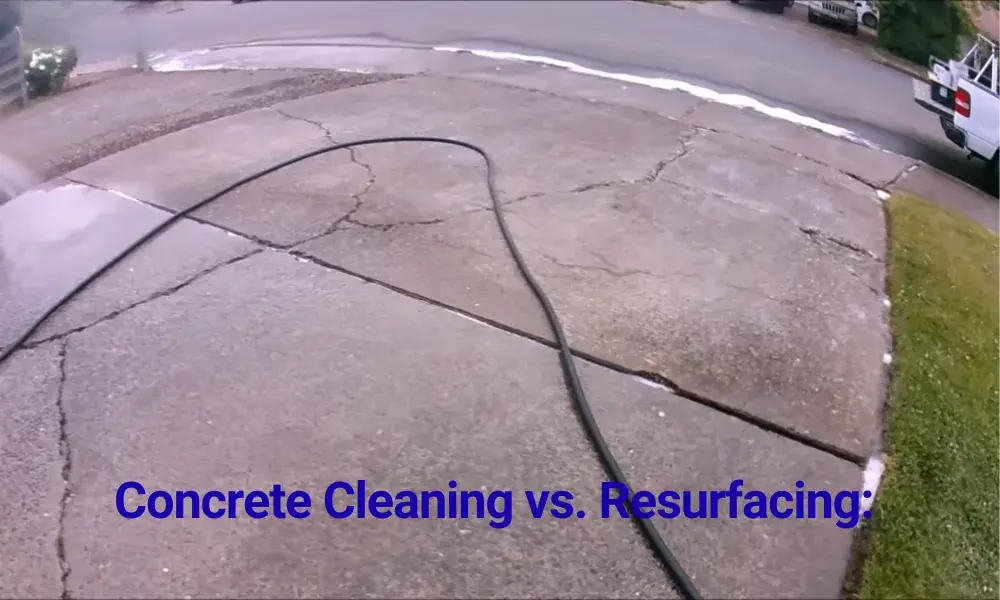
Cleaning is enough whenever the problem is on top of the concrete. Resurfacing is only needed when the concrete itself has changed. Discolouration, organic growth, tannin staining, oil spots and general dullness all sit on the surface. Deep spalling, wide cracks and slabs that have shifted do not.
The practical rule: clean first, judge on a dry slab, then decide. Cleaning costs a small fraction of resurfacing, and it has to happen before any overlay goes down anyway.
Almost every article you will find on this comparison is published by a company that sells resurfacing. That shapes the conclusion more than most homeowners realise. This one is written from the other side of the job, by people who clean concrete for a living in a climate that stains it aggressively.
We turn down work over this regularly. Someone books a quote convinced their driveway is finished, and the honest answer is that a single afternoon of pressure washing in Eugene will get them eighty percent of the way to a new slab for a couple of hundred dollars.
What each option actually does
These are not three points on one scale. They are three different interventions that solve three different problems, and picking the wrong one is expensive in both directions.
-
Surface
Cleaning
Removes what is sitting on the concrete: algae, moss, tannin, grime, most rust and oil. The slab underneath is unchanged.
Fixes appearance. Repairs nothing.
-
Cosmetic repair
Resurfacing
Bonds a thin cementitious overlay across the existing slab, giving a new wear layer and a new finish over sound structure.
Hides damage. Needs sound concrete beneath.
-
Structural
Replacement
Breaks out and re-pours the slab, including the base. The only real answer when the concrete has failed structurally.
Fixes everything. Costs the most.
Notice what resurfacing does not do. It does not repair a slab that is cracking because the base beneath it has settled. An overlay laid over a moving slab cracks along exactly the same lines within a season or two, because the movement is underneath it.
The five-minute test that answers this
You can settle the question yourself before anyone quotes you. All you need is a bucket, a stiff brush, some detergent and a dry day. Work on a small patch in the worst looking area, not the best.
-
Scrub one square foot as hard as you can
Wet the patch, apply detergent, and scrub with real effort for a minute. You are not trying to clean the driveway. You are trying to find out whether the colour comes back.
If the patch lightens noticeably, your problem is on the surface and professional cleaning will do across the whole slab what your brush just did to one square foot.
-
Let it dry completely, then look again
This step gets skipped and it invalidates everything. Wet concrete reads as uniformly dark, so a scrubbed wet patch always looks like a success.
Give it a few hours of dry weather. If the patch is clearly lighter than its surroundings when dry, cleaning works here. If it dried back to the same shade as everything around it, the discolouration is in the concrete, not on it.
-
Run a coin along the cracks
Hairline cracks and the fine web pattern called crazing are cosmetic. They come with concrete and they do not mean anything is failing.
A crack a coin edge drops into is a different conversation. So is any crack where one side sits higher than the other, because that means the ground underneath has moved.
-
Feel for the surface layer
Run your palm across the slab. Sound concrete feels consistent. Areas that feel noticeably rougher, sandy, or that shed grit onto your hand have lost their dense top layer.
Small patches of this are survivable and worth sealing. If it covers most of the driveway, cleaning will make it clean but it will still look tired, because the finish itself is gone.
-
Walk the slab and look for movement
Step firmly on each section, especially near cracks and edges. Anything that rocks, tilts or sounds hollow underfoot is sitting on a base that has washed out or settled.
This is the one finding that rules cleaning out entirely. No surface treatment fixes a foundation problem, and no overlay stays intact on top of one.
Scored four or five out of five for cleaning?
Then you have your answer, and it is the cheap one. A driveway that lightens under a brush, has only hairline cracks, feels consistent underfoot and does not move is sound concrete wearing eight months of Willamette Valley weather. It needs washing, not covering.
What the two options cost
The gap is the whole reason this decision matters. These are working ranges for a standard two-car residential driveway of roughly 600 square feet in the Eugene area, and every one of them varies with access, condition and material.
- $150–350 Professional driveway cleaning here
- $3–10 Per sq ft, typical resurfacing overlay
- $6–15 Per sq ft, typical full replacement
- 1 day Cleaning, vs days of cure time for an overlay
Run those numbers on 600 square feet and resurfacing lands somewhere in the low thousands, replacement higher again. Against a cleaning bill that tops out around $350, the asymmetry is the argument. Even in the cases where you eventually resurface, cleaning first costs you a rounding error and tells you what you are actually dealing with.
There is a timing element too. An overlay needs dry conditions to go down and to cure, which in this valley means a genuinely narrow window. Cleaning has a much longer season and does not lock up your driveway for days.
When cleaning is enough
In our experience most Eugene driveways that homeowners describe as worn out fall entirely into this list. Every item here is a surface condition, which means it responds to washing.
Seven problems a wash actually solves
If what is bothering you about the concrete appears below, you do not need an overlay.
- Green, black or grey biological growth. Algae, moss and lichen are organisms living on the slab, not damage to it
- Red-brown tannin staining. Leaf and fir needle drop leaches colour into the surface and lifts with the right treatment
- Oil and transmission fluid spots. Needs a degreaser and patience rather than an overlay
- Surface rust marks. From planters, patio furniture feet and fertiliser overspray
- General grey dullness. Years of road film and dust, which almost always hides a lighter slab
- Tyre marks and scuffing. Cosmetic, and confined to the top of the surface
- Hairline cracks and crazing. Cosmetic, normal, and not a reason to cover a driveway
Two of these have their own guides on this site, because they behave differently to everything else. Organic growth is covered in why Eugene driveways turn green, and oil is covered in removing oil stains from a concrete driveway — it is the one stain that sits below the surface rather than on it.
When cleaning is not enough
These are structural or substrate conditions, and no amount of washing touches them. Being honest about this list is what makes the rest of the article credible.
- Cracks wider than a coin edge, or cracks that have visibly opened over the past year
- Vertical displacement, where one side of a crack or joint sits higher than the other
- Widespread spalling, meaning the top layer has flaked away across large areas leaving shallow craters
- Exposed reinforcement, where rebar or mesh is visible in a crack or a spalled area
- Sections that rock or sound hollow underfoot, which points to a washed-out or settled base
- Standing water in the middle of the slab, which is a grading fault that resurfacing can sometimes correct and cleaning never will
- Deep colour damage, where a scrubbed patch dries back to exactly the same shade as everything around it
If you recognise two or more of these, the conversation has moved past our service and toward a concrete contractor. We would rather tell you that at the quote stage than take the money for a wash that leaves you disappointed.
Why cleaning comes first either way
Here is the part the resurfacing marketing tends to leave out. An overlay bonds to whatever is on the surface when it goes down. If that surface has algae film, oil residue, loose grit or a sealer that has started to fail, the overlay is bonding to those things rather than to the concrete.
How overlays fail
Delamination is the usual failure mode, and inadequate surface preparation is the usual cause. The overlay lifts away in sheets or patches, taking nothing of the original slab with it, because it never made a mechanical bond in the first place. The result looks worse than the concrete you started with and is harder to fix.
This is why cleaning and profiling the slab is a required stage of any competent resurfacing job, not an upsell. Anyone willing to overlay a dirty driveway is telling you something about the rest of their process.
Which produces a genuinely useful sequence. Clean the slab. Let it dry completely. Look at what you have got. In a large share of cases the decision resolves itself at that point, because a clean driveway looks dramatically better than the same driveway did under a decade of accumulated staining.
And if it does not resolve itself, you have spent a couple of hundred dollars to make your resurfacing contractor’s mandatory first step already done, on a surface you can now assess properly.
Why this decision goes differently in Eugene
Our climate produces concrete that looks far worse than it is. Around eight months of damp, a heavy tree canopy of Douglas fir and big-leaf maple, and long stretches where a shaded slab never fully dries between rains. That combination grows algae and drives tannin staining at a rate that a drier region simply does not see.
The consequence matters for this article. A driveway in Eugene can be structurally fine and still look like it belongs to an abandoned property, because the discolouration is biological rather than degradation. Homeowners read that appearance as age and price out replacement.
The freeze-thaw point runs the other way and deserves an honest mention. We get relatively few hard freezes here compared with eastern Oregon, so the classic freeze-thaw spalling that destroys concrete in colder climates is less common. When we do see genuine spalling locally it is more often from de-icing salt use, a poor original pour, or water sitting in one spot for years.
The one Eugene-specific caution about overlays
Moisture moving upward through a slab is a leading cause of overlay failure, and this is a wet valley with a high water table in places. If a driveway stays damp because of drainage rather than rainfall, that has to be solved before anything is bonded over the top. An overlay applied over a persistent moisture problem is a countdown, not a repair.
What to do if you are genuinely in between
Plenty of driveways are not clearly in either camp. Sound structure, no movement, but a worn finish and exposed aggregate that cleaning will reveal rather than repair. Three options sit between the extremes.
- Clean and seal. A penetrating sealer on sound, clean, dry concrete slows how fast staining and growth return and evens out the appearance. It is the highest-value middle step
- Clean and spot repair. Fill and patch individual cracks or spalled areas rather than treating the whole slab. Patches never match perfectly, but they stop deterioration spreading
- Clean now, resurface later. Buy a season, watch whether the cracks move, then commit. Concrete tells you what it is doing if you give it a year of observation on a clean surface
The same reasoning applies to the other hard surfaces around a property. A tired-looking patio or walkway is far more often stained than damaged, and the assessment runs identically: scrub a patch, dry it, look at it in daylight.
Getting a straight answer from a contractor
If someone has already told you the driveway needs replacing, four questions will tell you how solid that assessment is.
Four questions worth asking
None of these are confrontational. A good contractor will have ready answers.
- Was the slab clean and dry when you assessed it, and if not, would you look again after a wash?
- Which specific findings led to this recommendation — cracks, movement, spalling, or appearance?
- How will the surface be prepared before the overlay, and is that included in the quoted price?
- What happens if the existing cracks reappear through the new surface, and what is covered?
We will tell you when cleaning is not the answer. If the slab needs a concrete contractor rather than a wash, that is what the quote will say — see our driveway cleaning page for what is and is not included, and our full range of services for everything else around the property.
FAQs About Concrete Cleaning vs. Resurfacing
How do I know if my concrete needs resurfacing or just cleaning?
Wet a small patch and scrub it hard with a stiff brush and detergent. If the colour underneath comes back and matches the rest of the slab once dry, the problem is on the surface and cleaning will fix it. If the scrubbed patch dries to the same shade as the dirty concrete, the surface itself has changed and cleaning cannot restore it.
How much does concrete resurfacing cost compared to cleaning?
Resurfacing a driveway typically runs several dollars per square foot, which puts a standard two-car driveway in the low thousands. Professional cleaning of the same driveway in Eugene runs $150 to $350. The gap is large enough that cleaning first is worth doing even if you later decide to resurface anyway.
Can you resurface concrete without cleaning it first?
No responsible contractor will. An overlay bonds to whatever is on the surface, so applying it over algae film, oil residue or a failed sealer produces delamination rather than a repair. Cleaning and profiling the slab is a required first step of resurfacing, not an optional extra.
Will pressure washing fix discoloured concrete?
It fixes discolouration that sits on the surface, which covers organic growth, tannin staining from leaves and needles, general grey grime and most surface rust. It does not fix efflorescence that keeps returning, colour variation from the original pour, or the worn look of a slab whose dense top layer has already eroded away.
How wide does a crack have to be before cleaning is not enough?
Hairline cracks and crazing are cosmetic and cleaning handles them fine. Cracks wide enough to fit a coin edge, cracks where one side sits higher than the other, and cracks that have opened noticeably over a year are structural signals that a surface treatment will not address.
What is spalling and can cleaning fix it?
Spalling is when the top layer of concrete flakes or pops off, leaving shallow craters and exposed aggregate. Cleaning cannot put that material back. Light spalling can be left alone or sealed to slow it down, while widespread spalling with exposed reinforcement is a resurfacing or replacement job.
Does resurfacing last longer than cleaning?
A well-installed overlay lasts years rather than seasons, so in raw duration yes. The comparison is misleading though, because they solve different problems. Cleaning is maintenance you repeat annually on sound concrete, while resurfacing is a one-time repair for concrete that has genuinely degraded.
Should I seal my driveway after cleaning it?
Sealing after a clean is worthwhile on concrete that is sound but porous, because it slows how fast staining and organic growth take hold again. Seal only on a fully dry slab during a dry stretch, and never over growth that is still alive, since you would be sealing it in.
Is a concrete overlay a good idea in a wet climate like Eugene?
It can work, but the preparation matters more here than in a dry climate. Moisture moving up through a slab is a leading cause of overlay failure, so drainage problems and constant damp need solving before anything is applied over the top.
My contractor says the driveway needs replacing. Should I get another opinion?
Get one if the assessment was made on a dirty slab. Heavy organic growth and staining hide the actual condition of concrete, and a surface cannot be judged properly until it is clean and dry. Cleaning first costs a fraction of the quoted work and makes any second opinion far more reliable.
Can cleaning make old concrete look new again?
It can restore the original colour of the slab, which is often a bigger change than people expect. What it cannot do is change the finish itself, so a broom finish stays a broom finish and worn aggregate stays exposed. Cleaning reveals the concrete you have rather than giving you a different one.
How long should I wait after cleaning before deciding on resurfacing?
Wait until the slab is completely dry, which usually means a full day of dry weather. Wet concrete looks uniformly dark and hides both the improvement and the remaining faults, so any decision made on a damp driveway is being made on bad information.
Dirty and damaged look the same. They are not.
The whole decision comes down to one distinction, and a stiff brush settles it in five minutes. Surface problems clean off. Structural problems do not.
So do the cheap thing first. Clean the slab, let it dry, and look at it in daylight. Most Eugene driveways stop the conversation right there. The ones that do not have told you something worth knowing before you spent thousands finding it out the expensive way.
When did you last see your driveway completely clean and dry?
Find Out What Your Concrete Looks Like Clean
Tell us the driveway size, the surface material, and what is bothering you about it. We will tell you whether a wash fixes it — and say so plainly if it does not.
Evergreen Surface Care provides pressure washing Eugene, OR and nearby Lane County. Free written estimate. Surface-safe methods. No surprise charges.